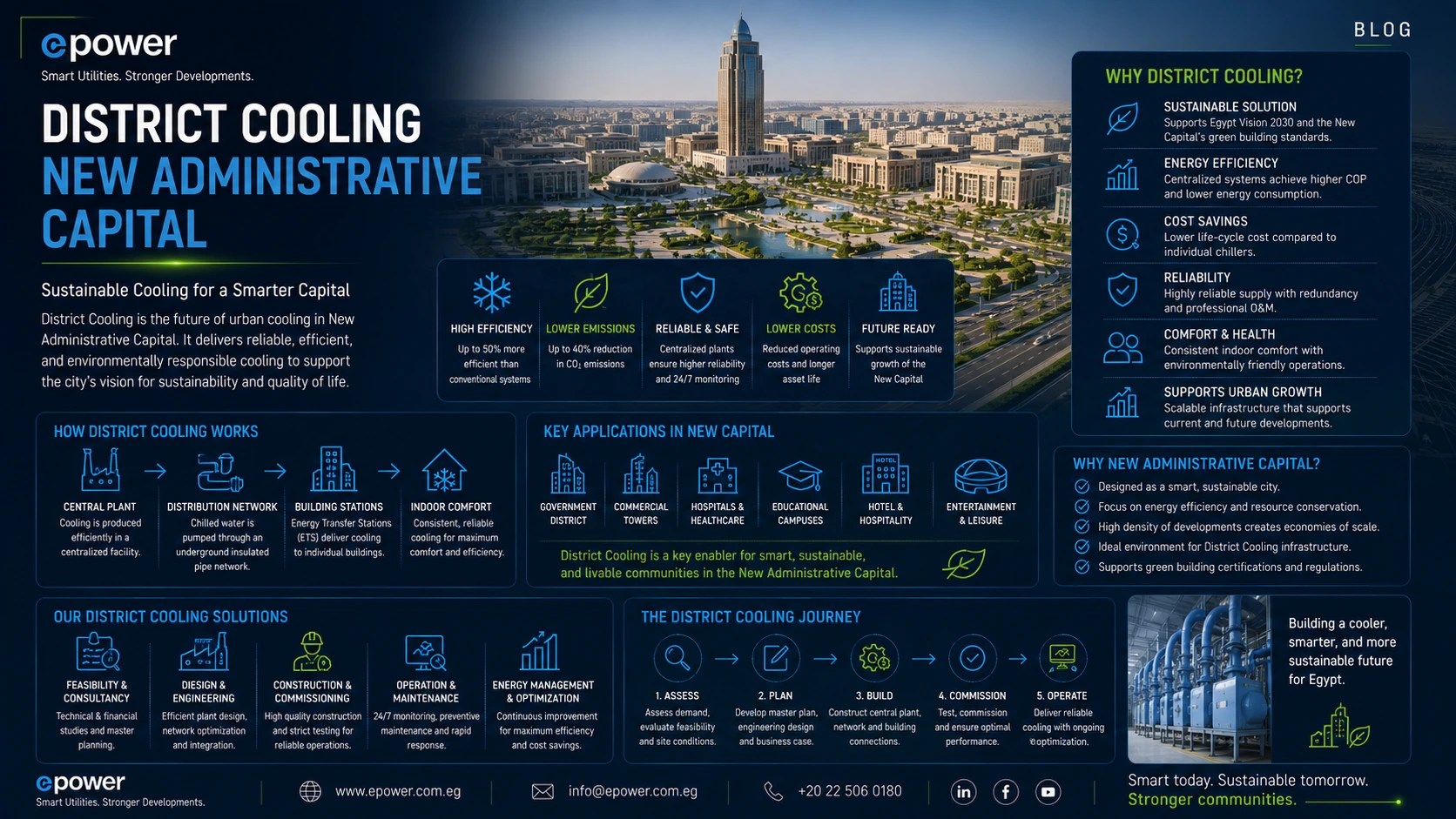
The District Cooling New Administrative Capital system is one of Egypt's most significant centralized cooling infrastructure projects. Designed to serve large government, financial, commercial, and administrative developments, district cooling provides chilled water from centralized plants instead of relying on individual cooling systems in every building.
The New Administrative Capital has become an important example of how centralized utilities can support large-scale urban development while improving energy management and operational efficiency. ACUD describes its district cooling infrastructure as one of the city's key smart and sustainable systems.
What Is District Cooling?
How District Cooling Works
District cooling is a centralized air-conditioning system in which one or more large cooling plants produce chilled water and distribute it through a network of insulated underground pipes to connected buildings.
Inside each building, an Energy Transfer Station (ETS) transfers cooling energy from the district network to the building's internal chilled-water system.
The basic process is:
- Central chillers produce chilled water.
- Chilled water is distributed through underground networks.
- Buildings receive chilled water through an ETS.
- Heat is transferred from the building's cooling system to the district network.
- Warmer return water goes back to the central plant.
- The plant cools the water again and repeats the cycle.
This approach centralizes cooling production and allows multiple buildings to share large-scale cooling infrastructure.
District Cooling in the New Administrative Capital
A Major Centralized Cooling Network
The New Administrative Capital has adopted district cooling as part of its utility infrastructure for major districts.
The main central cooling plant associated with the Government and Financial Districts has been reported by project participants as having an initial capacity of approximately 64,000 refrigeration tons (RT), with the infrastructure designed for expansion. Hassan Allam describes the project as a 50,000-RT plant expandable to 64,000 RT, serving the Government District, Financial District, and more than 180 buildings.
ACUD currently describes the district cooling plant as having 64,000 tons of initial capacity, with an expansion target of 300,000 tons over five years, serving the Government District, Financial District, and city operations buildings.
Why the New Capital Needs District Cooling
The scale and density of the New Administrative Capital make centralized cooling particularly relevant.
The city contains:
- Government buildings
- Ministries
- Financial institutions
- Office towers
- Commercial developments
- Hotels
- Residential buildings
- High-rise towers
- Central Business District facilities
Cooling demand across these buildings can be substantial, particularly during Egypt's hot summer months.
A centralized network provides an alternative to installing separate large chiller plants in every building.
District Cooling and the Central Business District
Cooling the CBD
District cooling is particularly important in the Central Business District, where large towers and high-density developments require significant cooling capacity.
The Central Business District includes the Iconic Tower and multiple administrative, commercial, residential, and hospitality buildings. The Egyptian Real Estate Platform reports that the CBD includes 20 towers and a large range of mixed-use facilities.
Iconic Tower Connection
The Iconic Tower has been connected to the municipal cooling system.
According to CSCEC, its cooling system includes six plate heat-exchanger rooms, 15 plate heat exchangers, 21 chilled-water pumps, 97 AHUs, and 1,043 FCUs. The connection allowed the tower's internal HVAC system to receive cooling from the centralized network.
This demonstrates how district cooling can support extremely large buildings without requiring every tower to operate its own independent central cooling plant.
Main Components of District Cooling Infrastructure
Central Chillers
Large centrifugal or absorption chillers generate chilled water at the central plant.
The New Administrative Capital's plant includes both centrifugal and absorption chillers. Hassan Allam reports 11 centrifugal chillers rated at approximately 3,300 TR each and 10 absorption chillers rated at approximately 1,250 TR each.
Cooling Towers
Cooling towers reject heat from the cooling system and are an important part of many water-cooled district cooling plants.
Chilled-Water Pumps
Pumps circulate chilled water between the central plant and connected buildings.
Pump selection and control have a significant impact on the overall energy performance of the system.
Distribution Network
The chilled-water distribution network connects the cooling plant with buildings throughout the district.
The CBD Central Utility Complex, for example, includes approximately six kilometers of cooling pipelines using pre-insulated pipes with diameters reaching up to 1.4 meters, according to CSCEC. The network also incorporates leak detection.
Energy Transfer Stations
Each connected building requires an Energy Transfer Station or equivalent interface to connect its internal HVAC system with the district cooling network.
The ETS can contain:
- Heat exchangers
- Pumps
- Control valves
- Flow meters
- Temperature sensors
- Pressure sensors
- Control systems
This creates a controlled interface between the centralized utility network and the building.
Energy Efficiency Benefits of District Cooling
Centralized Cooling Production
Large centralized plants can use high-capacity chillers and optimize equipment operation according to the overall cooling demand.
Instead of each building operating separate chillers at varying efficiency levels, cooling production can be coordinated across the district.
Load Diversity
One of the important advantages of district cooling is load diversity.
Different buildings have different cooling patterns. Office buildings may experience peak demand during working hours, while residential or hospitality buildings may have different demand profiles.
A centralized system can take advantage of these differences.
Thermal Energy Storage
Thermal energy storage can allow cooling to be produced during lower-demand periods and used during peak periods.
The New Administrative Capital's district cooling project incorporates thermal energy storage technology. Gascool describes the ACUD system as combining natural gas, electricity, and a thermal energy storage tank system.
Reducing Peak Electrical Demand
Thermal storage and centralized load management can reduce the electrical capacity required during peak periods.
Project documentation from Tricom Controls states that the ACUD district cooling system was designed with power and load optimization that could provide power savings of up to 20% under the project's operating strategy.
Actual savings, however, depend on operating conditions, load profiles, equipment efficiency, and system management.
District Cooling vs Individual Building Chillers
Individual Cooling Systems
In a conventional development, each building may have its own chiller plant.
This means every building requires:
- Chillers
- Cooling towers
- Pumps
- Electrical infrastructure
- Plant rooms
- Maintenance teams
- Spare parts
- Control systems
Centralized District Cooling
With district cooling, major cooling production infrastructure is centralized.
Connected buildings primarily require:
- ETS
- Internal chilled-water distribution
- AHUs
- FCUs
- Pumps and controls where required
Comparison
FactorDistrict CoolingIndividual ChillersCooling productionCentralizedBuilding-by-buildingPlant infrastructureSharedDuplicatedMaintenanceCentralizedMultiple locationsEnergy managementCentralizedDecentralizedExpansionNetwork-basedIndividual systemsThermal storageEasier to centralizeMore difficultMonitoringCentral platformMultiple systems
The best option depends on development scale, density, cooling load, infrastructure costs, operating model, and long-term planning.
Benefits of District Cooling for Developers
Lower Infrastructure Duplication
Developers can avoid installing a complete large chiller plant in every building when centralized cooling infrastructure is available.
Better Space Utilization
Removing or reducing large chiller plants can potentially free valuable building space for other uses.
Centralized Operations
Cooling equipment can be monitored and maintained through a centralized operational model.
Scalability
A district cooling network can expand as new buildings are added, provided that sufficient plant and network capacity is planned.
Improved Energy Management
Centralized monitoring allows operators to analyze cooling demand across the network and optimize plant performance.
District Cooling and Smart City Infrastructure
Digital Monitoring
Modern district cooling systems can incorporate SCADA, automation, sensors, and centralized control systems.
The ACUD cooling infrastructure includes advanced automation and SCADA technologies for monitoring and controlling plant and remote systems.
Data-Driven Operations
Operators can monitor:
- Chilled-water temperatures
- Flow rates
- Differential pressure
- Chiller efficiency
- Pump performance
- Cooling demand
- Energy consumption
- Equipment alarms
This information can support predictive maintenance and energy optimization.
Integration With Building Management
District cooling can also be integrated with building management systems, allowing building operators to coordinate internal HVAC demand with the district network.
Challenges of District Cooling in the New Capital
High Initial Investment
Central plants and distribution networks require significant upfront capital investment.
Network Planning
The cooling network must be planned before buildings are connected.
Pipe routes, capacity, future phases, and building connection points need to be coordinated with urban development.
Customer Connection
Every connected building needs appropriate hydraulic, mechanical, electrical, and control interfaces.
Operational Management
District cooling requires specialized expertise in:
- Chillers
- Hydraulics
- Controls
- Water treatment
- Energy management
- Preventive maintenance
Long-Term Demand Forecasting
Cooling capacity needs to match actual development growth. Overestimating demand can create unnecessary capital expenditure, while underestimating demand can constrain future expansion.
District Cooling for Future Developments in the New Capital
Expanding Network Capacity
As the New Administrative Capital continues to develop, cooling demand is expected to expand across new districts and buildings.
ACUD currently identifies an expansion pathway from the initial 64,000-ton capacity toward approximately 300,000 tons over five years.
New Commercial and Mixed-Use Projects
District cooling can be particularly suitable for:
- Business districts
- Office parks
- Shopping centers
- Hotels
- High-rise developments
- Mixed-use communities
- Large residential compounds
Integration With Energy Management
Future cooling infrastructure can increasingly combine district cooling with smart metering, energy analytics, renewable electricity, thermal storage, and automated controls.
This creates a more integrated utility-management model for large-scale urban developments.
How to Optimize District Cooling Performance
Monitor Chiller Efficiency
Operators should continuously monitor chiller performance and compare actual efficiency against expected operating conditions.
Optimize Pumping
Variable-speed pumping and differential-pressure optimization can reduce unnecessary pumping energy.
Manage Chilled-Water Temperature
Maintaining appropriate supply and return temperatures is essential for efficient system operation.
Control Thermal Storage
Thermal energy storage should be operated according to demand forecasts, electricity conditions, and cooling requirements.
Maintain Water Quality
Water treatment is critical for cooling towers and chilled-water systems because poor water quality can affect heat transfer, equipment reliability, and system efficiency.
Use Preventive and Predictive Maintenance
Regular maintenance helps protect chillers, pumps, cooling towers, valves, heat exchangers, and control systems.
Why Choose epower?
epower provides integrated utility and energy-management solutions for large-scale developments, including electrical infrastructure, smart metering, energy monitoring, and utility operations.
For developments that depend on centralized cooling, an integrated utility approach can help connect cooling performance with the wider electrical and energy infrastructure.
epower can support developers and operators with utility monitoring, energy-performance analysis, infrastructure management, and operational optimization, helping large developments improve reliability while maintaining visibility over long-term utility costs.
For projects in the New Administrative Capital and other emerging Egyptian cities, combining district cooling with smart utility management can create a more efficient and scalable infrastructure model.
Conclusion
District Cooling New Administrative Capital represents a major shift toward centralized utility infrastructure in Egypt's new urban developments.
The New Administrative Capital's large cooling plants demonstrate how district cooling can serve government buildings, financial districts, high-rise towers, and other major facilities through shared chilled-water infrastructure. The system combines large-scale chillers, distribution networks, energy transfer stations, automation, and thermal energy storage to support the cooling requirements of a rapidly developing city.
For developers, the main value of district cooling is not simply centralized air conditioning. It is the ability to create a coordinated cooling infrastructure that can be monitored, optimized, expanded, and integrated with broader smart-city utility systems.
As development continues in the New Administrative Capital, district cooling can play an increasingly important role in improving energy performance, managing peak demand, and supporting reliable cooling for large-scale developments.
Frequently Asked Questions
What is district cooling in the New Administrative Capital?
District cooling in the New Administrative Capital is a centralized cooling system that produces chilled water at large plants and distributes it through underground networks to connected buildings.
How large is the district cooling plant in the New Administrative Capital?
The initial system is reported at approximately 64,000 refrigeration tons (RT). ACUD currently states that the capacity is planned to expand toward approximately 300,000 tons over five years.
Which areas does the district cooling system serve?
The central district cooling infrastructure serves major areas including the Government District and Financial District, with project sources indicating service to more than 180 buildings.
Does the Iconic Tower use district cooling?
Yes. CSCEC reported that the Iconic Tower's cooling system was connected to the municipal cooling system and successfully started operation.
Is district cooling more energy efficient than individual chillers?
It can be, particularly for large, dense developments where centralized plants can benefit from equipment efficiency, load diversity, optimized operation, and thermal energy storage. Actual performance depends on system design and operation.
What is an Energy Transfer Station?
An Energy Transfer Station connects a building's internal HVAC system to the district cooling network, typically using heat exchangers, pumps, valves, meters, sensors, and control equipment.
Why is thermal energy storage used in district cooling?
Thermal energy storage allows cooling capacity to be shifted between different periods, potentially reducing peak electrical demand and improving plant utilization.
Is district cooling suitable for residential compounds?
Yes. District cooling can be suitable for large residential compounds and master-planned communities where cooling demand is sufficiently concentrated and centralized infrastructure can be economically justified. A UN-backed feasibility study specifically identified district cooling as a potential solution for newly established cities and large residential compounds in Egypt.
Why is district cooling important for the New Administrative Capital?
The New Administrative Capital contains large numbers of high-rise, government, commercial, financial, and mixed-use buildings. Centralized cooling allows these facilities to share large-scale cooling infrastructure and supports the city's broader smart-utility strategy.