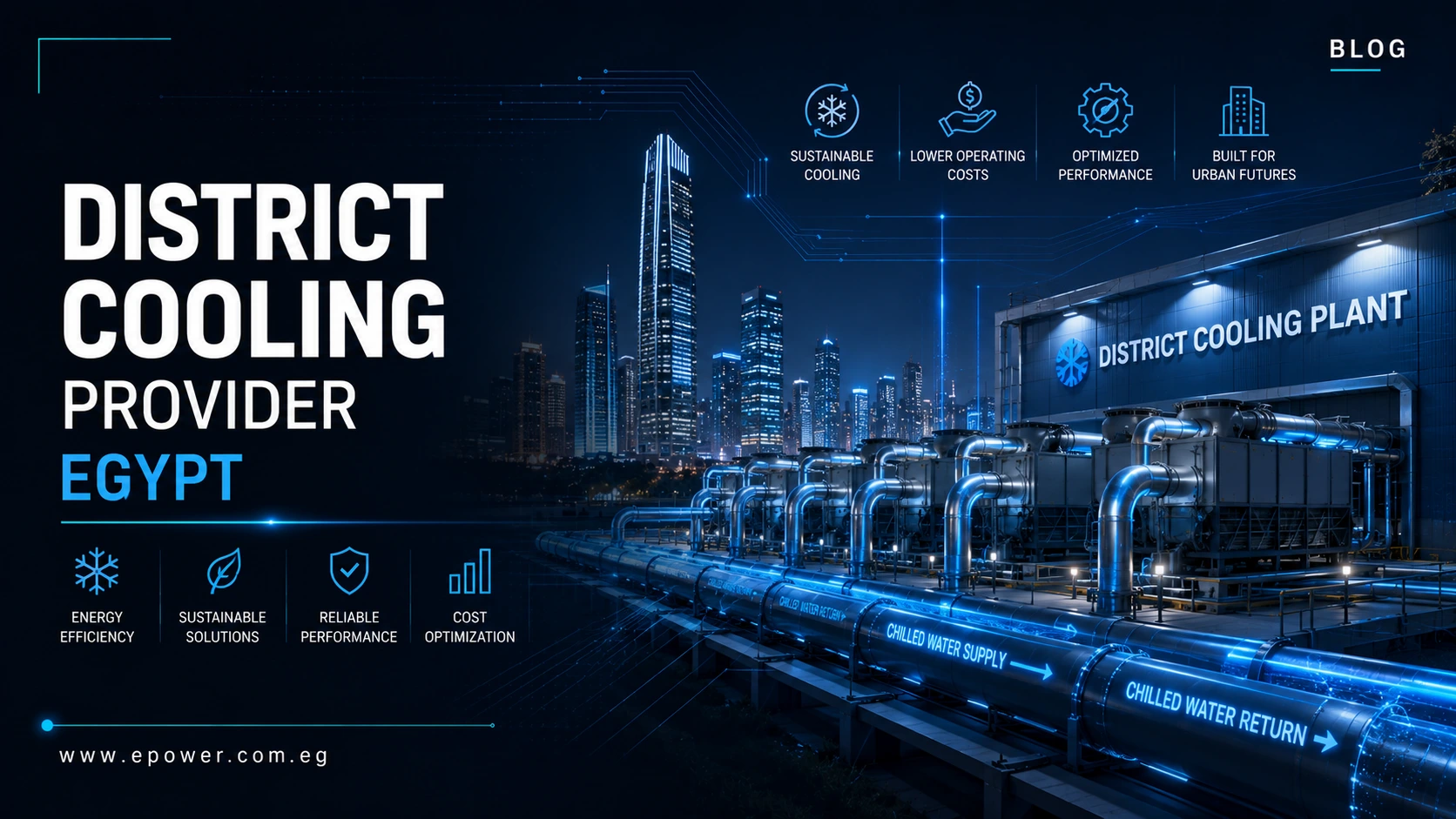
As Egypt continues to develop smart cities, mixed-use communities, business parks, airports, hospitals, and large commercial developments, the demand for sustainable cooling solutions has grown significantly. Traditional air conditioning systems often consume large amounts of electricity, require extensive maintenance, and occupy valuable building space.
This is why choosing a reliable District Cooling Provider Egypt has become an essential decision for developers and facility owners seeking long-term operational efficiency. District cooling systems produce chilled water at a centralized cooling plant and distribute it through an underground pipe network to multiple buildings, delivering reliable and energy-efficient cooling across an entire district. Studies indicate these systems can significantly reduce electricity consumption compared to conventional cooling methods while lowering greenhouse gas emissions.
What is District Cooling?
Definition
A District Cooling Provider Egypt designs, builds, operates, and maintains centralized cooling systems that serve multiple buildings from a single cooling plant.
Instead of installing separate chillers in every building, chilled water is generated centrally and circulated through insulated underground pipelines to connected facilities, where heat exchangers transfer cooling to each building's HVAC system.
How District Cooling Works
The system operates through a simple but highly efficient process:
Central Cooling Plant
High-efficiency chillers produce chilled water at a central plant.
Distribution Network
The chilled water travels through insulated underground pipes to connected buildings.
Energy Transfer Stations
Each building receives chilled water through heat exchangers that cool indoor air without mixing building water with the district network.
Water Return Cycle
After absorbing heat, the water returns to the central plant where it is cooled again, creating a continuous closed-loop system.
Core Services Offered by a District Cooling Provider Egypt
Engineering and System Design
Every project begins with detailed engineering studies, including:
- Cooling load analysis
- Hydraulic calculations
- Plant sizing
- Pipe network design
- Energy modeling
- Equipment selection
Proper design ensures the cooling system meets current and future demand while maximizing energy efficiency.
EPC Services
Many district cooling providers offer complete Engineering, Procurement, and Construction (EPC) services, including:
Plant Construction
Building central cooling plants equipped with high-efficiency chillers, pumps, cooling towers, and automation systems.
Underground Distribution Networks
Installing insulated pipe networks that transport chilled water between the cooling plant and connected buildings.
Commissioning
Testing, balancing, and commissioning the complete system before operation.
Operations and Maintenance
Long-term system performance depends on professional operation and maintenance.
Typical services include:
- 24/7 system monitoring
- Preventive maintenance
- Equipment inspections
- Performance optimization
- Emergency response
- Asset lifecycle management
Continuous monitoring helps maximize plant efficiency while minimizing downtime.
Energy Management
Modern district cooling systems rely on advanced digital technologies to optimize energy usage.
These technologies include:
- SCADA systems
- Building Management Systems (BMS)
- IoT sensors
- Smart energy monitoring
- Predictive maintenance
- Performance analytics
By analyzing system performance in real time, operators can improve efficiency while reducing operating costs.
Benefits of Choosing a District Cooling Provider Egypt
Lower Energy Consumption
District cooling systems use centralized high-efficiency equipment that consumes significantly less electricity than conventional building-by-building cooling systems.
Reduced Operating Costs
Centralized maintenance and optimized equipment operation lower maintenance expenses and reduce lifecycle costs.
Improved Reliability
Professional providers continuously monitor system performance, ensuring uninterrupted cooling even during peak demand periods.
More Usable Building Space
Without individual chiller plants in every building, developers gain additional rooftop and mechanical room space for commercial or operational use.
Environmental Sustainability
District cooling reduces electricity demand and carbon emissions while supporting green building initiatives and sustainability goals.
Scalable Infrastructure
As new buildings are added to a development, they can often be connected to the existing cooling network without requiring standalone cooling systems.
Applications of District Cooling in Egypt
Smart Cities
Large smart city developments rely on district cooling to provide sustainable and efficient climate control across multiple buildings.
Residential Communities
Luxury compounds and mixed-use developments benefit from centralized cooling that improves operational efficiency and resident comfort.
Commercial Complexes
Office towers, shopping malls, and business districts require reliable cooling systems capable of handling varying occupancy levels.
Healthcare Facilities
Hospitals depend on continuous cooling for patient comfort and the operation of sensitive medical equipment.
Hotels and Resorts
Hospitality projects benefit from stable cooling performance while reducing energy consumption and maintenance costs.
Airports and Infrastructure Projects
Large transportation hubs require district cooling systems capable of operating continuously under demanding conditions.
Why District Cooling is Growing in Egypt
Egypt's rapid urban expansion and increasing focus on sustainable infrastructure have accelerated the adoption of district cooling technologies. Early landmark projects demonstrated the feasibility of centralized cooling, and newer smart city developments continue to integrate district cooling as part of their long-term energy strategies.
Why Choose epower?
epower delivers comprehensive district cooling solutions tailored to the needs of modern developments across Egypt. From feasibility studies and engineering design to EPC execution, commissioning, operation, and long-term maintenance, the company provides complete lifecycle support for centralized cooling infrastructure.
Leveraging experienced engineering teams and advanced energy management technologies, epower develops reliable and scalable cooling systems that reduce energy consumption, improve operational efficiency, and support sustainable urban development. Whether serving residential communities, commercial developments, industrial facilities, or mixed-use projects, epower is committed to delivering high-performance district cooling solutions that meet international engineering standards while maximizing long-term value for clients.
Conclusion
As demand for sustainable and energy-efficient infrastructure continues to grow, selecting the right District Cooling Provider Egypt is becoming increasingly important for developers and facility owners. District cooling offers a smarter alternative to conventional air conditioning by reducing energy consumption, lowering maintenance costs, improving reliability, and supporting environmental sustainability.
With expert engineering, advanced technologies, and proactive operational management, district cooling systems provide a future-ready solution for Egypt's expanding cities and large-scale developments.
Frequently Asked Questions
What is a District Cooling Provider Egypt?
A district cooling provider designs, builds, operates, and maintains centralized cooling systems that deliver chilled water to multiple buildings through a shared distribution network.
How does district cooling differ from traditional air conditioning?
Instead of individual chillers in each building, district cooling uses one central plant to produce chilled water that serves an entire development, improving efficiency and reducing energy consumption.
What types of projects benefit from district cooling?
Smart cities, residential compounds, office parks, hospitals, hotels, airports, universities, shopping malls, and mixed-use developments all benefit from district cooling.
Is district cooling more energy efficient?
Yes. Centralized cooling systems can reduce electricity consumption and operating costs compared to conventional building-based cooling solutions while also lowering environmental impact.
What services should a district cooling provider offer?
A complete provider should offer engineering, EPC services, plant construction, underground piping, commissioning, operations, maintenance, energy monitoring, and lifecycle asset management.
Why choose epower as your District Cooling Provider Egypt?
epower provides end-to-end district cooling solutions, combining engineering expertise, advanced technologies, EPC execution, and long-term operational support to deliver reliable, energy-efficient, and sustainable cooling systems for projects across Egypt.