
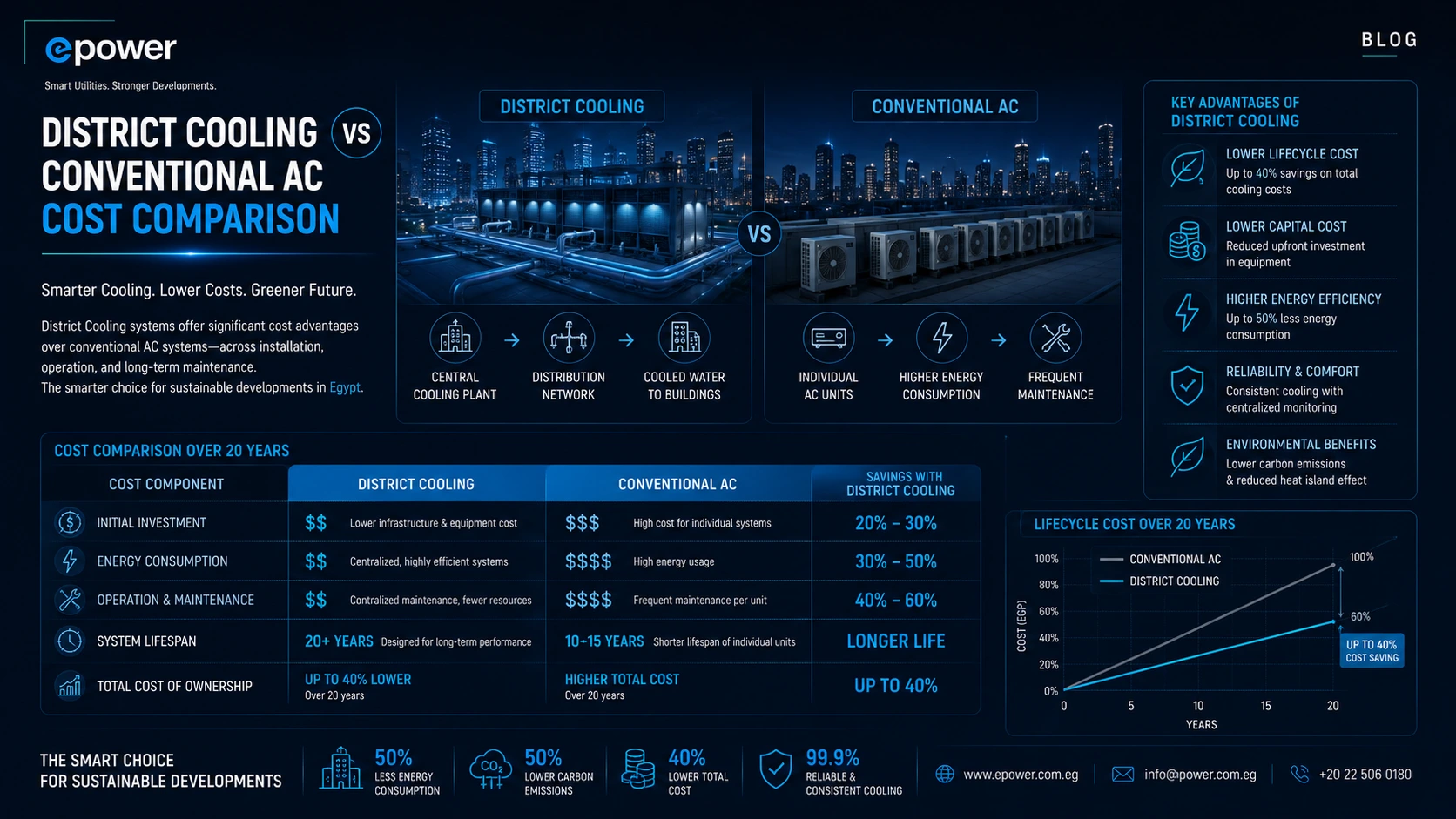
Cooling systems represent one of the largest operational expenses for residential communities, commercial buildings, hotels, hospitals, and mixed-use developments—especially in hot climates like Egypt. As developers seek more energy-efficient and sustainable solutions, district cooling has emerged as an attractive alternative to traditional air conditioning systems.
When comparing District Cooling vs Conventional AC Cost, it's important to look beyond the initial investment. Installation costs, energy consumption, maintenance, equipment lifespan, operational efficiency, and lifecycle expenses all influence the total cost of ownership.
Understanding these factors helps developers, facility managers, and investors choose the most cost-effective cooling solution for their projects.
What is District Cooling?
Definition
District cooling is a centralized cooling system that produces chilled water at a central plant and distributes it through an insulated pipe network to multiple buildings.
Instead of each building operating its own chillers and cooling equipment, the centralized plant supplies cooling energy to the entire development.
District cooling is commonly used in:
- Mixed-use developments
- Smart cities
- Residential compounds
- Business districts
- Hotels and resorts
- Hospitals
- Airports
- University campuses
What is Conventional Air Conditioning?
Conventional air conditioning uses independent cooling systems installed in each building or facility.
These systems may include:
- Split air conditioners
- Package units
- VRF/VRV systems
- Rooftop units
- Individual chillers
Each building is responsible for operating and maintaining its own cooling equipment.
Initial Installation Cost
District Cooling
District cooling generally requires a higher upfront investment because it involves:
- Central cooling plant construction
- Chillers
- Pump stations
- Thermal energy storage (if applicable)
- Underground insulated piping network
- Control systems
However, these costs are shared across multiple buildings, making district cooling increasingly economical for large developments.
Conventional AC
Conventional systems usually have lower initial installation costs for individual buildings because each property installs its own equipment independently.
Installation typically includes:
- Air conditioning units
- Refrigerant piping
- Electrical connections
- Indoor units
- Outdoor condensers
For small standalone buildings, conventional systems often require less capital investment.
Operating Cost Comparison
District Cooling
District cooling plants are designed for maximum efficiency.
Benefits include:
- Lower electricity consumption
- Centralized energy optimization
- High-efficiency chillers
- Reduced peak demand
- Continuous performance monitoring
These efficiencies often result in lower operating costs, particularly in large-scale developments with high cooling demand.
Conventional AC
Operating costs can be higher because:
- Multiple systems operate independently.
- Equipment efficiency varies between buildings.
- Maintenance quality may differ.
- Peak electricity demand increases during hot seasons.
Older or poorly maintained systems typically consume significantly more energy than centralized district cooling plants.
Energy Efficiency
District cooling systems generally achieve higher energy efficiency by:
- Utilizing high-capacity chillers
- Operating equipment at optimal load conditions
- Sharing cooling capacity across multiple buildings
- Reducing redundant equipment
- Optimizing cooling production based on demand
Conventional systems often operate below peak efficiency, especially during partial-load conditions.
Maintenance Cost
District Cooling
Maintenance is centralized and managed by specialized operators.
Advantages include:
- Professional maintenance teams
- Predictive maintenance
- Lower equipment redundancy
- Simplified servicing
- Reduced maintenance costs per building
Conventional AC
Each building is responsible for maintaining its own cooling equipment.
Maintenance includes:
- Compressor servicing
- Refrigerant charging
- Filter replacement
- Coil cleaning
- Fan maintenance
- Equipment replacement
Managing numerous independent systems generally increases long-term maintenance costs.
Equipment Lifespan
District cooling equipment is designed for continuous industrial operation and is typically maintained under structured maintenance programs.
Benefits include:
- Longer equipment life
- Better operational reliability
- Lower replacement frequency
- Improved asset utilization
Individual air conditioning systems often have shorter replacement cycles due to varying maintenance practices and operating conditions.
Space Requirements
District Cooling
Buildings connected to district cooling require significantly less mechanical space because major cooling equipment is located in the central plant.
This frees valuable building space for:
- Additional retail
- Parking
- Residential units
- Storage
- Technical facilities
Conventional AC
Each building requires dedicated space for:
- Outdoor condensers
- Mechanical rooms
- Cooling towers (where applicable)
- Chillers
- Equipment access
This reduces usable building area.
Environmental Impact
District cooling contributes to sustainability by:
- Lower electricity consumption
- Reduced carbon emissions
- Higher energy efficiency
- Optimized water usage
- Centralized environmental management
Conventional systems generally consume more electricity and require larger quantities of refrigerants spread across many separate units.
Which Projects Benefit Most from District Cooling?
District cooling is ideal for:
- Smart cities
- Large residential compounds
- Mixed-use developments
- Commercial districts
- Airports
- Hotels and resorts
- Healthcare campuses
- University campuses
- Government developments
Conventional AC is often more practical for:
- Small office buildings
- Individual villas
- Standalone retail stores
- Small commercial buildings
- Low-rise residential projects
Cost Comparison Summary
Cost Factor
District Cooling
Conventional AC
Initial Investment
Higher
Lower
Operating Cost
Lower
Higher
Energy Efficiency
Excellent
Moderate
Maintenance Cost
Lower over time
Higher over time
Equipment Lifespan
Longer
Shorter
Space Requirements
Minimal inside buildings
Larger mechanical spaces
Scalability
Excellent
Limited
Sustainability
High
Moderate
Why Choose epower?
epower delivers integrated district cooling and utility infrastructure solutions for residential compounds, commercial developments, hospitality projects, industrial facilities, and smart cities across Egypt. From engineering design and EPC execution to utility management, operation, and maintenance, epower develops energy-efficient cooling systems that improve operational performance and reduce long-term ownership costs.
With expertise in district cooling networks, electrical infrastructure, smart utility management, and energy optimization, epower helps developers select the most suitable cooling strategy based on project size, operational requirements, and long-term investment objectives.
Conclusion
When evaluating District Cooling vs Conventional AC Cost, the best solution depends on the size, complexity, and long-term goals of the development. While conventional air conditioning may require a lower initial investment for smaller projects, district cooling delivers significant long-term advantages through lower operating costs, higher energy efficiency, reduced maintenance, and improved sustainability.
For large-scale developments, district cooling provides a future-ready cooling infrastructure that supports operational excellence, enhances asset value, and contributes to more sustainable urban communities.
Frequently Asked Questions
What is the main difference between district cooling and conventional AC?
District cooling uses a centralized plant to supply chilled water to multiple buildings, while conventional air conditioning relies on individual cooling systems installed in each building.
Is district cooling more expensive to install?
Yes. District cooling generally requires a higher upfront investment due to the construction of central plants and distribution networks. However, it often delivers lower operating costs over the life of the project.
Which system has lower operating costs?
District cooling typically has lower operating costs because centralized high-efficiency equipment consumes less energy and is optimized across multiple buildings.
Is district cooling more energy efficient?
Yes. District cooling systems generally achieve higher energy efficiency by using centralized equipment, optimizing load management, and reducing redundant cooling infrastructure.
Which projects are best suited for district cooling?
Large residential communities, mixed-use developments, commercial districts, hotels, hospitals, airports, and smart cities benefit most from district cooling systems.
Why choose epower for district cooling solutions?
epower provides end-to-end district cooling solutions, including engineering, EPC, utility management, and operation & maintenance services, helping developers build efficient, reliable, and sustainable cooling infrastructure that supports long-term operational success.