
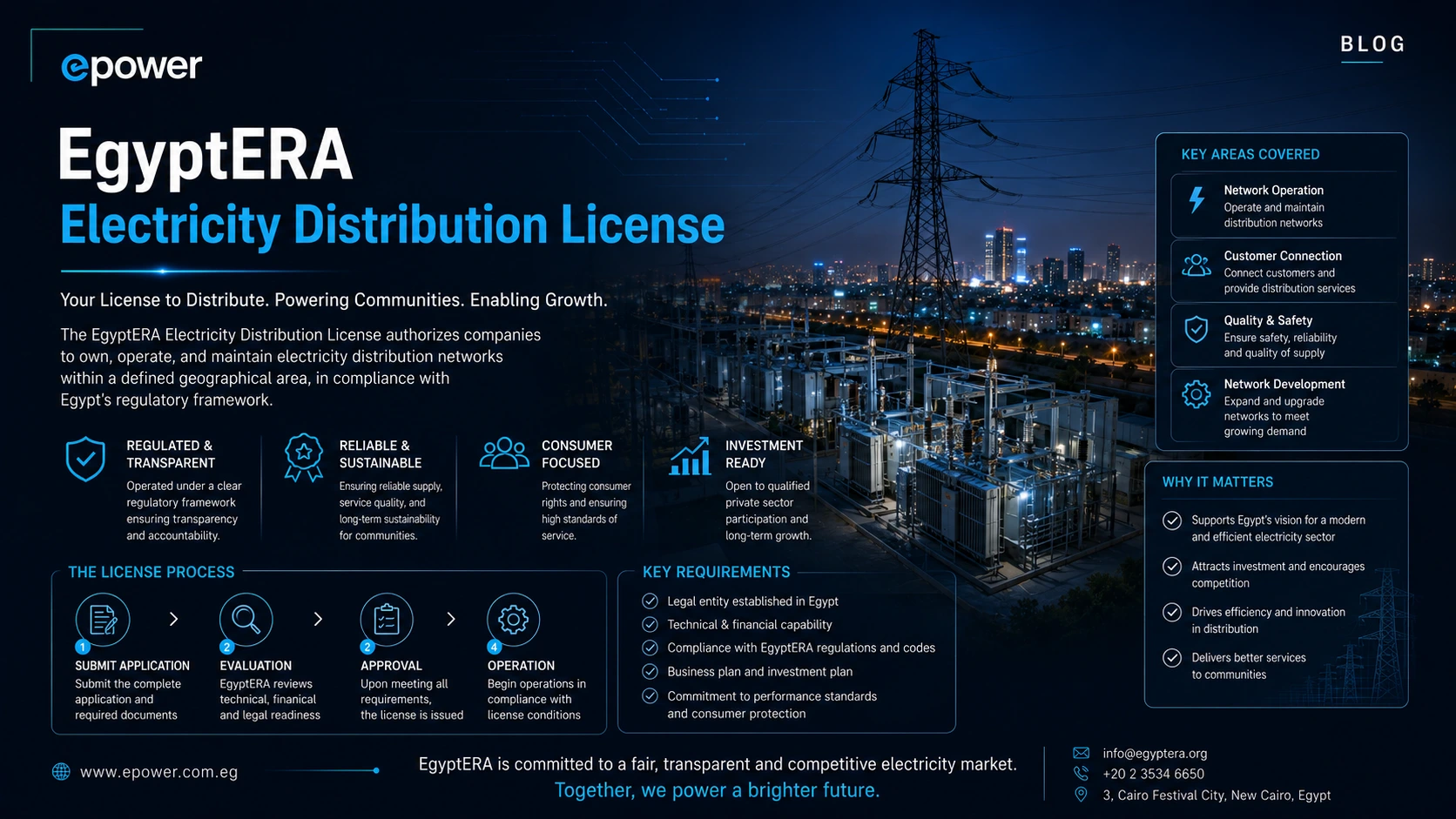
As Egypt continues to expand its power infrastructure, private developers, industrial zones, smart cities, residential compounds, and mixed-use developments are increasingly participating in electricity distribution projects. To legally distribute electricity within a licensed service area, organizations must obtain an EgyptERA Electricity Distribution License issued by the Egypt Electric Utility and Consumer Protection Regulatory Agency (EgyptERA).
Obtaining the appropriate license ensures that electricity distribution activities comply with the Egyptian Electricity Law, technical regulations, safety standards, and consumer protection requirements. For developers planning private distribution networks, understanding the licensing process is an essential step before operating or managing electrical infrastructure. EgyptERA provides dedicated procedures for first-time licenses, renewals, and expanding the licensed scope of distribution projects.
What is an EgyptERA Electricity Distribution License?
Definition
An EgyptERA Electricity Distribution License is an official authorization issued by EgyptERA that permits eligible companies to operate, manage, maintain, and distribute electrical power within an approved geographical area in accordance with Egyptian regulations.
The license applies to organizations responsible for operating electricity distribution networks serving residential, commercial, industrial, and mixed-use developments.
Why is the License Required?
Obtaining the appropriate license ensures that electricity distribution activities are performed safely, efficiently, and in compliance with national regulations.
The license helps ensure:
- Regulatory compliance
- Safe network operation
- Reliable electricity distribution
- Consumer protection
- Technical standard compliance
- Operational accountability
Licensed operators are also responsible for maintaining distribution infrastructure and meeting the obligations defined under Egypt's Electricity Law.
Who Needs an EgyptERA Electricity Distribution License?
Organizations that may require a distribution license include:
Real Estate Developers
Large residential compounds and mixed-use developments operating private electricity distribution networks.
Industrial Parks
Industrial zones managing electrical infrastructure for multiple factories and facilities.
Smart Cities
Integrated urban developments with privately operated utility networks.
Commercial Developments
Business parks, shopping malls, and commercial complexes operating private electrical distribution systems.
Infrastructure Operators
Organizations responsible for distributing electricity within licensed service areas.
Key Responsibilities of Licensed Distribution Companies
Under the Egyptian Electricity Law, licensed distribution companies are responsible for several operational activities.
Distribution Network Operation
Managing medium- and low-voltage electricity distribution networks within the licensed service area.
Operation and Maintenance
Operating, inspecting, maintaining, and upgrading electrical infrastructure to ensure continuous service.
Customer Supply
Supplying electricity to eligible consumers in accordance with approved tariffs and regulatory requirements.
Network Expansion
Planning and implementing network expansion projects to accommodate future electricity demand.
Technical Compliance
Ensuring all distribution activities comply with EgyptERA regulations, technical standards, and safety requirements.
EgyptERA Licensing Process
Although specific project requirements vary depending on the development, the licensing process generally includes several stages.
Initial Assessment
Applicants evaluate project requirements, service areas, technical scope, and regulatory obligations before submitting an application.
Technical Documentation
Applicants prepare engineering documents, network designs, technical studies, and supporting documentation required by EgyptERA.
Application Submission
The complete licensing application is submitted to EgyptERA using the official licensing forms and supporting documents. EgyptERA publishes dedicated application templates for first-time licenses, renewals, and project scope extensions.
Technical Review
EgyptERA reviews the submitted documentation to verify compliance with applicable technical, operational, and regulatory requirements.
License Approval
Upon successful review and approval, the organization receives authorization to practice electricity distribution activities within the approved scope.
Related Permits
Before obtaining a distribution license, developers may also need a permit for establishing or expanding a distribution network. EgyptERA reviews feasibility studies and technical documentation before issuing these permits.
Benefits of Professional Licensing Support
Faster Application Preparation
Experienced engineering consultants prepare technical documentation that aligns with regulatory expectations.
Regulatory Compliance
Professional guidance helps reduce application errors and ensures documentation meets EgyptERA requirements.
Engineering Expertise
Specialists assist with electrical studies, network design, technical reports, and supporting calculations.
Reduced Project Delays
Accurate submissions help streamline the licensing process and minimize delays caused by incomplete documentation.
Long-Term Operational Readiness
Proper licensing preparation ensures projects are ready for compliant operation after construction and commissioning.
Applications Across Different Sectors
Residential Compounds
Private electrical distribution networks serving gated communities and residential developments.
Commercial Developments
Shopping malls, office complexes, and retail destinations requiring dedicated electrical distribution systems.
Industrial Facilities
Factories and industrial zones operating medium-voltage distribution infrastructure.
Mixed-Use Projects
Large developments integrating residential, commercial, hospitality, and entertainment facilities.
Smart Cities
Modern developments utilizing advanced electrical infrastructure supported by licensed utility operators.
Why Choose epower?
epower provides comprehensive engineering and utility solutions that support developers throughout the electricity distribution project lifecycle. From feasibility studies and electrical network design to EPC execution, utility management, commissioning, and operational support, epower helps clients develop reliable distribution infrastructure that aligns with EgyptERA requirements.
With extensive experience in power distribution, electrical engineering, and utility management, epower works with developers, industrial facilities, commercial projects, and smart city initiatives to deliver efficient, scalable, and compliant electrical distribution solutions. Whether supporting new infrastructure or expanding existing utility networks, epower combines technical expertise with practical project execution to help clients achieve long-term operational success.
Conclusion
Obtaining an EgyptERA Electricity Distribution License is a critical step for organizations planning to operate private electricity distribution networks in Egypt. The licensing process ensures compliance with national regulations, promotes safe and reliable electrical infrastructure, and supports sustainable utility operations.
By working with experienced engineering professionals, developers can simplify the licensing process, improve project readiness, and build electrical distribution systems that meet both operational and regulatory requirements.
Frequently Asked Questions
What is an EgyptERA Electricity Distribution License?
It is an official authorization issued by EgyptERA that allows qualified organizations to operate and manage electricity distribution networks within an approved service area.
Who needs an electricity distribution license in Egypt?
Real estate developers, industrial parks, commercial developments, smart cities, and organizations operating private electricity distribution networks may require this license.
What does a licensed distribution company do?
Licensed companies manage electricity distribution networks, maintain infrastructure, supply electricity to consumers, expand networks, and comply with EgyptERA technical and regulatory requirements.
Can a distribution network be expanded after licensing?
Yes. EgyptERA provides procedures for requesting the inclusion of new project areas within an existing licensed distribution scope.
Is a construction permit different from a distribution license?
Yes. A permit generally covers the establishment or expansion of a distribution network, while the distribution license authorizes the operation of the electricity distribution activity.
Why choose epower for electricity distribution projects?
epower delivers integrated electrical engineering, EPC, utility management, and technical support services that help developers build reliable, efficient, and regulation-ready electricity distribution infrastructure across Egypt.