
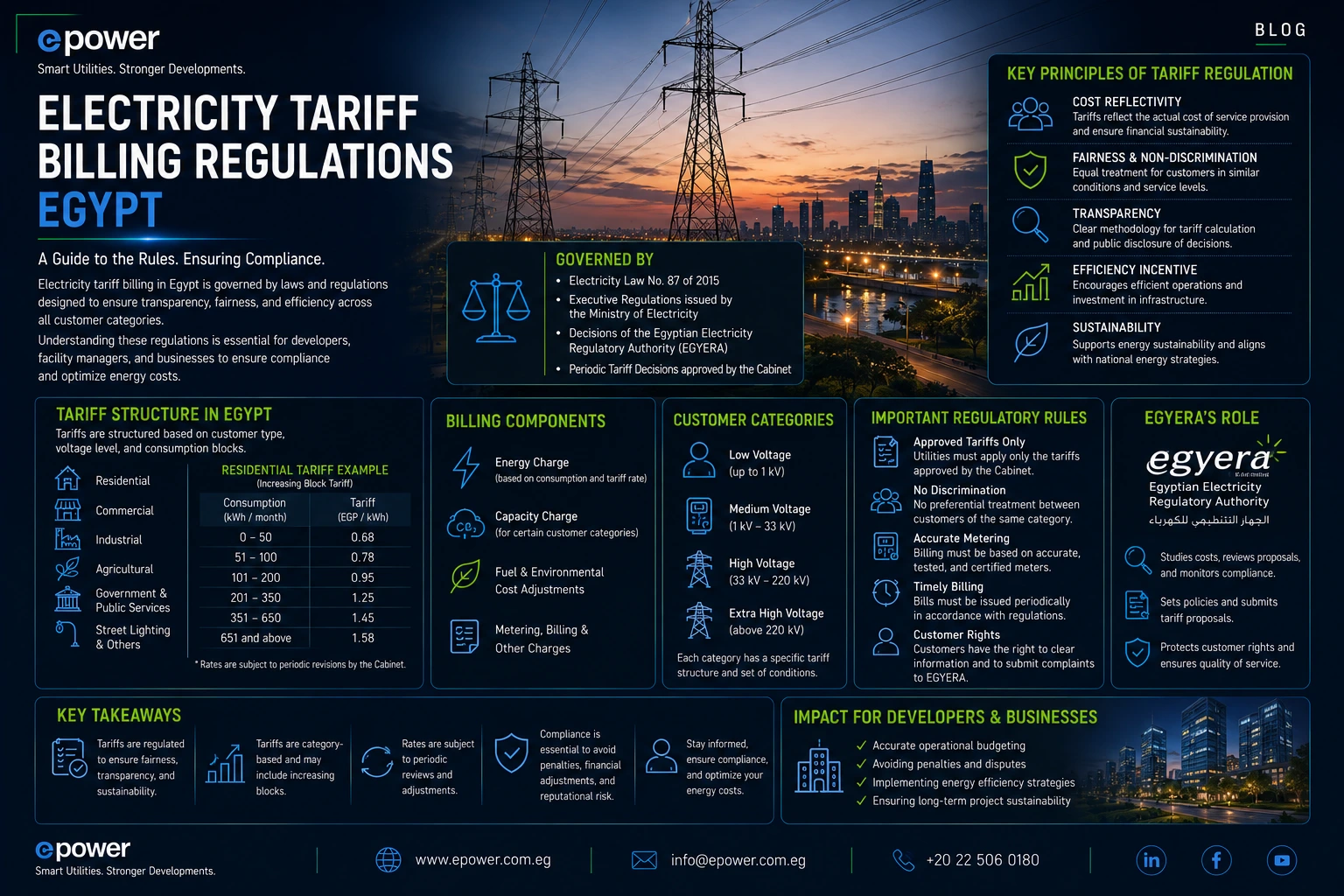
Understanding Electricity Tariff Billing Regulations Egypt is essential for developers, utility operators, commercial customers, industrial facilities, and residential communities managing electricity supply and billing. EgyptERA regulates electricity tariffs and publishes the applicable rules, tariff structures, commercial regulations, and consumer guidance.
As of April 2026, EgyptERA's published electricity tariff includes different rates according to voltage level, consumption category, and type of use. Billing therefore depends not only on electricity consumption but also on the applicable customer classification, meter, service charges, and other regulated components.
What Are Electricity Tariff Billing Regulations in Egypt?
Definition
Electricity Tariff Billing Regulations Egypt refer to the regulatory framework governing how electricity is priced, measured, billed, supplied, and collected from consumers.
The framework covers areas such as:
- Electricity tariff structures
- Consumer classification
- Meter readings
- Billing calculations
- Electricity supply contracts
- Customer service charges
- Commercial regulations
- Consumer rights and obligations
- Connection requirements
- Complaint procedures
EgyptERA publishes regulatory rules and commercial regulations for electricity distribution companies, while the Egyptian Electricity Holding Company and its distribution companies handle electricity supply and related customer services.
Who Regulates Electricity Tariffs in Egypt?
Role of EgyptERA
The Egyptian Electric Utility and Consumer Protection Regulatory Agency (EgyptERA) plays a central regulatory role in the electricity sector.
Its published resources include:
- Current electricity tariffs
- Billing calculation tools
- Commercial regulations
- Electricity connection guidance
- Consumer information
- Distribution licensing requirements
- Regulatory circulars and decisions
EgyptERA also maintains historical tariff information, allowing consumers and businesses to distinguish between current and previous tariff structures.
Electricity Distribution Companies
Distribution companies supply electricity to consumers within their designated service areas and apply the approved tariff structure to customer accounts.
EgyptERA explains that electricity supply contracts differ according to consumer type, including residential, commercial, and non-residential consumers connected at medium or low voltage.
How Is Electricity Tariff Calculated?
Consumption-Based Billing
Electricity billing generally starts with the amount of electricity consumed, measured in kilowatt-hours (kWh).
The applicable tariff depends on the customer's category and consumption structure.
For example, EgyptERA's tariff effective from electricity consumption beginning in April 2026 lists separate rates for residential consumers, commercial users, code meters, and consumers connected at different voltage levels.
Residential Tariffs
The April 2026 tariff published by EgyptERA uses different residential consumption bands. The published rates range from 68 piastres/kWh for 0–50 kWh to 258 piastres/kWh for consumption above 1,000 kWh, depending on the applicable consumption category.
This means residential billing should not be calculated simply by multiplying total consumption by one universal rate without considering the applicable tariff structure.
Commercial Tariffs
Commercial consumers are also subject to consumption-based categories.
Under the tariff effective from April 2026, EgyptERA publishes commercial rates ranging from 162 piastres/kWh for the lowest listed consumption category to 279 piastres/kWh for the highest listed category.
The exact calculation should always be based on the current official tariff and the customer's classification.
Electricity Tariff by Voltage Level
Medium Voltage
Medium-voltage electricity users are subject to tariff rates that differ from low-voltage consumers.
EgyptERA's April 2026 tariff lists a rate of 255 piastres/kWh for several medium-voltage user categories, with a separate rate for distribution companies linked to the transmission network.
Low Voltage
For low-voltage electricity at 380 V, the April 2026 published tariff lists 274 piastres/kWh for general users and public lighting, while irrigation is listed separately.
High and Extra-High Voltage
Large industrial and infrastructure consumers connected at higher voltage levels are subject to different tariff structures.
This makes voltage level an important consideration when evaluating electricity costs for industrial developments and large infrastructure projects.
Customer Service Charges
What Are Customer Service Fees?
Electricity bills may include regulated customer service charges in addition to consumption charges.
EgyptERA's April 2026 tariff lists customer service fees according to voltage and consumer category. For example, extra-high, high, and medium-voltage users are listed at EGP 35 per user per month, while residential and commercial charges vary according to consumption category.
Therefore, calculating electricity costs requires considering more than the kWh tariff alone.
Electricity Meter Readings and Billing
Registered Meter Readings
Meter readings form the basis of electricity billing.
EgyptERA's commercial regulations state that accounting is performed monthly according to registered meter readings and the electricity supply contract between the company and the subscriber or consumer.
This makes accurate meter management essential for both electricity distributors and consumers.
Smart Metering
Smart meters can improve the accuracy and efficiency of electricity billing by automatically recording consumption data and transmitting it to centralized systems.
Smart metering can support:
- Remote meter reading
- Consumption monitoring
- Automated billing
- Tamper detection
- Consumption analytics
- Remote service management
For large developments, smart metering can also help operators allocate electricity consumption between residential units, commercial tenants, common areas, and infrastructure.
Prepaid and Code Meters
Prepaid Electricity
Prepaid systems allow consumers to pay for electricity before consumption. This model can improve payment control and reduce outstanding balances.
Code Meters
EgyptERA publishes a specific tariff category for code meters. Under the tariff effective from April 2026, the published code-meter rate is 274 piastres/kWh.
The specific circumstances surrounding installation and operation of a code meter should be verified with the relevant electricity service provider and current regulatory requirements.
Electricity Supply Contracts
Residential Contracts
EgyptERA provides standard electricity supply contracts for residential units.
Commercial Contracts
Commercial customers may operate under different contractual arrangements based on their use and connection characteristics.
Non-Residential Medium and Low Voltage
EgyptERA also publishes standard contracts for non-residential facilities connected at medium and low voltage.
For developers and utility operators, understanding the applicable supply contract is important because tariff application and billing responsibilities are connected to the contractual relationship.
Power Factor and Electricity Tariffs
Why Power Factor Matters
Power factor can affect the way electrical systems operate and is particularly important for large commercial and industrial consumers.
EgyptERA states that the current tariff is applied based on a power factor of 0.92.
Maintaining appropriate power factor performance can therefore be an important part of electrical energy management for large developments.
Electricity Billing for Real Estate Developments
Residential Compounds
Large residential compounds may have thousands of individual electricity meters alongside common-area consumption.
A professional utility management model can separate:
- Residential consumption
- Clubhouse consumption
- Street lighting
- Water pumping
- Security facilities
- Administrative buildings
- Commercial areas
Smart metering and centralized utility platforms can simplify this process.
Commercial Developments
Shopping malls, office buildings, and mixed-use projects require accurate tenant-level consumption measurement.
This supports transparent billing and enables property managers to identify abnormal consumption.
Industrial Developments
Industrial consumers may have significantly higher loads and medium- or high-voltage connections.
Their electricity cost analysis should consider:
- Voltage level
- Consumption
- Power factor
- Load profile
- Maximum demand where applicable
- Metering accuracy
- Network losses
How Utility Management Improves Billing Accuracy
Centralized Meter Monitoring
A centralized platform can collect data from multiple meters and provide a consolidated view of consumption.
Automated Data Validation
Automated systems can identify unusual readings, missing data, communication failures, or sudden consumption changes.
Consumption Analytics
Historical consumption data can help utility operators understand demand patterns and identify potential technical problems.
Transparent Customer Billing
Accurate consumption records provide a stronger basis for transparent and auditable billing.
Electricity Tariff Changes and Regulatory Updates
Electricity tariffs and regulatory requirements can change over time. Developers and utility operators should therefore avoid relying on outdated tariff tables.
EgyptERA maintains current tariff information as well as historical tariffs and publishes periodic regulatory books when rules are updated. For example, EgyptERA's 2026 periodic publications include a circular modifying the main electricity supply connection rules for medium- and low-voltage facilities.
For any commercial agreement, tariff calculation, or utility management project, the applicable tariff should be verified against the latest official EgyptERA publication.
Best Practices for Electricity Billing Management
Use Accurate Metering
Metering systems should be properly installed, maintained, tested, and monitored.
Maintain Updated Customer Data
Customer classification, meter information, connection type, and contractual details should remain accurate.
Monitor Consumption Trends
Sudden changes in consumption can indicate equipment problems, incorrect readings, leaks in related utility systems, or unauthorized consumption.
Maintain Billing Records
Detailed billing records create an audit trail and support dispute resolution.
Verify Regulatory Updates
Utility teams should regularly review EgyptERA publications to ensure tariff calculations and procedures remain aligned with current requirements.
Why Choose epower?
epower provides integrated electricity distribution, metering, and utility management solutions for residential, commercial, and industrial developments across Egypt.
Its metering solutions include smart and prepaid meter deployment, unified management platforms, mobile payment integration, and consumption analytics. epower also provides electricity distribution and utility operations services focused on efficiency, reliability, and regulatory compliance.
For developers and large communities, this integrated approach can help improve meter data quality, support transparent consumption management, optimize utility operations, and provide better visibility into electricity costs.
Conclusion
Understanding Electricity Tariff Billing Regulations Egypt is essential for anyone responsible for electricity supply, distribution, billing, or utility management. Electricity costs are determined through regulated tariff structures that vary according to consumer category, consumption, voltage level, meter type, and applicable charges.
For large developments, accurate metering and professional utility management are particularly important because thousands of individual consumption points may need to be monitored and billed.
The best approach is to combine accurate metering, centralized data management, transparent billing processes, and continuous monitoring of EgyptERA's latest regulatory publications. This allows developers and utility operators to improve billing accuracy while maintaining compliance with the applicable electricity framework.
Frequently Asked Questions
Who regulates electricity tariffs in Egypt?
EgyptERA, the Egyptian Electric Utility and Consumer Protection Regulatory Agency, publishes and regulates the applicable electricity tariff framework and related regulatory information.
How is an electricity bill calculated in Egypt?
The calculation depends on the applicable consumer category, electricity consumption, tariff structure, meter type, and additional regulated charges such as customer service fees. EgyptERA provides an official bill-calculation tool based on the current tariff.
What is the current electricity tariff in Egypt?
The applicable tariff depends on the consumer category and voltage level. EgyptERA's current published tariff applies to electricity consumption beginning in April 2026 and includes separate residential, commercial, industrial, and voltage-based rates.
Are electricity tariffs the same for residential and commercial consumers?
No. EgyptERA publishes different tariff structures for residential, commercial, code-meter, and non-residential consumers, with rates also varying according to consumption and voltage level.
Does power factor affect electricity tariffs?
EgyptERA states that the current tariff is applied based on a power factor of 0.92. Power factor management is therefore particularly relevant for large electricity consumers.
Can smart meters improve electricity billing?
Yes. Smart meters can automate consumption measurement, improve data availability, support remote reading, detect abnormal consumption, and integrate with centralized billing and utility management systems.
How often should electricity tariffs be checked?
Businesses and utility operators should check official EgyptERA publications whenever preparing billing models, contracts, budgets, or tariff-based calculations because regulatory requirements and tariff structures can change.
Why choose epower for electricity billing and utility management?
epower provides smart and prepaid metering, consumption analytics, utility operations, and electricity distribution solutions that help developments improve billing accuracy, utility visibility, and operational efficiency.