
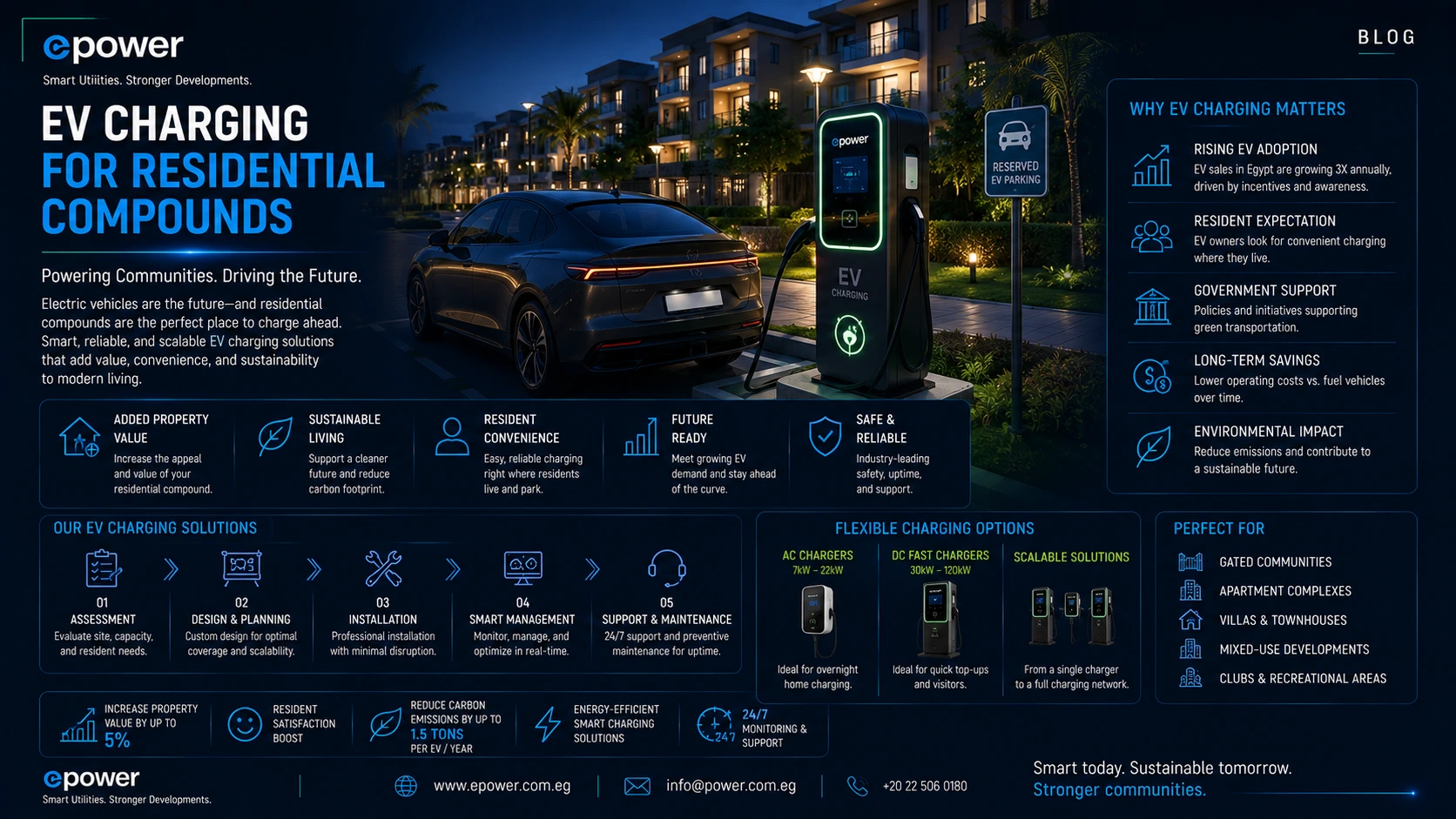
The growth of electric vehicles is changing the way residential communities plan their electrical infrastructure. As more residents transition from conventional cars to EVs, residential compounds need reliable, accessible, and scalable charging solutions that can support current demand and future adoption.
Implementing EV Charging for Residential Compounds requires more than simply installing charging stations. Developers need to consider electrical capacity, charger selection, parking layouts, load management, metering, billing, safety, and future expansion.
A well-designed EV charging network can improve resident convenience, increase property attractiveness, support sustainability goals, and prepare residential developments for the future of electric mobility.
What is EV Charging for Residential Compounds?
Definition
EV Charging for Residential Compounds refers to the planning, installation, operation, and management of electric vehicle charging infrastructure within gated communities, apartment complexes, villas, and residential developments.
A complete charging infrastructure can include:
- AC charging stations
- DC fast chargers
- Electrical distribution systems
- Transformers
- Distribution panels
- Smart meters
- Load management systems
- Charging management software
- Payment and billing platforms
- Communication networks
The infrastructure should be designed according to the development's electrical capacity, number of residents, parking configuration, and expected EV adoption rate.
Why Residential Compounds Need EV Charging Infrastructure
Growing EV Adoption
As electric mobility expands, residents increasingly expect their communities to provide convenient charging options close to their homes.
Unlike public charging stations, residential charging allows EV owners to charge their vehicles while they sleep, work from home, or remain parked for extended periods.
Future-Proofing Residential Developments
Installing the necessary electrical infrastructure during the initial development phase can be significantly easier than retrofitting buildings and parking areas later.
Developers can plan:
- Electrical capacity
- Cable routes
- Distribution boards
- Parking spaces
- Metering
- Communication infrastructure
This creates a scalable foundation for future EV charging expansion.
Increasing Property Appeal
EV-ready communities can become more attractive to environmentally conscious buyers and tenants. Charging infrastructure can also become an additional amenity that differentiates premium residential developments.
Types of EV Chargers for Residential Compounds
AC Charging
AC chargers are generally well suited to residential environments because vehicles typically remain parked for several hours.
They can be installed in:
- Villa parking areas
- Apartment parking spaces
- Residential garages
- Community parking facilities
The relatively long parking duration makes overnight charging practical for many residents.
DC Fast Charging
DC fast chargers deliver significantly higher charging power and can recharge vehicles much faster than typical AC charging.
They may be appropriate for:
- Visitor parking
- Clubhouses
- Community centers
- Commercial areas within mixed-use compounds
- High-demand charging locations
However, DC charging typically requires greater electrical capacity and more substantial infrastructure.
Electrical Infrastructure Requirements
Electrical Load Assessment
Before installing chargers, developers should evaluate the available electrical capacity and estimate potential EV charging demand.
The assessment should consider:
- Existing electrical load
- Number of parking spaces
- Expected EV adoption
- Charger power ratings
- Peak demand
- Future expansion
- Transformer capacity
Without proper load planning, simultaneous charging could create excessive demand on the development's electrical network.
Distribution Equipment
Depending on the project's scale, EV charging may require additional:
- Transformers
- Switchgear
- Distribution boards
- Protection devices
- Cables
- Metering equipment
The charging network should be integrated into the development's overall electrical distribution strategy rather than treated as an isolated installation.
Smart Charging and Load Management
Why Load Management Matters
If multiple residents connect their vehicles simultaneously, charging demand can increase significantly.
Smart charging systems can distribute available electrical capacity among vehicles based on predefined rules.
For example, the system can prioritize:
- Available electrical capacity
- Vehicle charging requirements
- User-selected charging times
- Peak and off-peak periods
- Development-wide energy demand
Dynamic Load Balancing
Dynamic load balancing continuously monitors the electrical network and adjusts charger output according to real-time demand.
This helps prevent unnecessary overloads and allows more vehicles to charge without requiring immediate upgrades to the entire electrical infrastructure.
Smart Metering for EV Charging
Individual Consumption Measurement
Smart meters can measure electricity consumed by each charging station or user.
This is particularly useful in residential compounds where electricity costs need to be allocated fairly among residents.
Automated Billing
Charging management platforms can connect consumption data with billing systems.
Residents may be charged based on:
- kWh consumed
- Charging session
- Time of use
- Subscription
- Fixed service fees
Automated billing reduces administrative work and improves transparency.
EV Charging Management Software
Modern charging networks use centralized software to manage stations and users.
Common Features
A charging management platform can provide:
- Charger availability
- User authentication
- Remote monitoring
- Charging session management
- Energy consumption reports
- Billing
- Fault notifications
- Maintenance alerts
- Usage analytics
Residents can potentially use mobile applications to locate available chargers, start charging sessions, monitor consumption, and receive notifications.
EV Charging Installation Considerations
Charger Location
Charging stations should be positioned where they are convenient for residents while minimizing cable lengths and infrastructure costs.
Parking design should consider:
- Dedicated EV spaces
- Accessibility
- Cable routing
- Vehicle movement
- Pedestrian safety
- Future expansion
Electrical Safety
EV charging infrastructure should incorporate appropriate electrical protection, grounding, isolation, and installation practices according to applicable codes and standards.
Weather Protection
Outdoor chargers should be appropriately selected and installed for local environmental conditions, including heat, dust, moisture, and exposure to sunlight.
Future Expansion
Developers should avoid designing a system only for today's EV demand.
A better strategy is to install sufficient electrical infrastructure and pathways that allow additional chargers to be added as adoption increases.
Benefits of EV Charging for Residential Compounds
Greater Resident Convenience
Residents can charge their vehicles at home rather than depending entirely on public charging stations.
Increased Property Value
EV-ready developments can provide an additional amenity that supports market differentiation and long-term property attractiveness.
Better Energy Management
Smart charging allows communities to monitor and optimize electricity consumption.
Reduced Environmental Impact
Supporting electric mobility can contribute to lower transportation-related emissions when EVs are charged using increasingly cleaner electricity sources.
Future-Ready Infrastructure
Scalable charging infrastructure prepares residential developments for increasing EV adoption without requiring major redesigns.
EV Charging and Renewable Energy
Solar-Powered EV Charging
Residential compounds can integrate EV chargers with photovoltaic solar systems.
Solar energy can help supply part of the charging demand, particularly during daylight hours.
Battery Energy Storage
Battery storage can potentially be integrated with EV charging infrastructure to manage peak demand and improve utilization of renewable energy.
Smart Energy Management
Combining EV charging, solar generation, battery storage, and smart metering creates a more integrated energy ecosystem for the residential development.
Challenges of EV Charging in Residential Communities
Limited Electrical Capacity
Existing developments may not have enough electrical capacity to support large numbers of simultaneous chargers.
High Initial Infrastructure Costs
Installing transformers, cables, distribution equipment, and charging stations requires upfront investment.
Parking Management
Not every resident may have a dedicated parking space, requiring fair allocation and charging policies.
Billing Complexity
Developments need clear policies for allocating electricity costs between residents, management, and charging operators.
Maintenance
Charging stations require regular inspection, software management, preventive maintenance, and responsive technical support.
How to Implement EV Charging in a Residential Compound
Step 1: Assess the Existing Electrical Network
Evaluate transformers, feeders, distribution panels, available capacity, and existing peak demand.
Step 2: Forecast EV Demand
Estimate current and future EV ownership within the development.
Step 3: Select Charger Types
Choose AC and DC charging according to parking duration, user requirements, and available electrical capacity.
Step 4: Design the Infrastructure
Develop electrical layouts, cable routes, protection systems, metering, communications, and charger locations.
Step 5: Implement Smart Charging
Introduce load management to optimize available electrical capacity.
Step 6: Integrate Billing and Monitoring
Connect chargers with smart meters and charging management software.
Step 7: Establish Operation and Maintenance
Define preventive maintenance, technical support, emergency response, and performance monitoring procedures.
Why Choose epower?
epower provides end-to-end EV Charging for Residential Compounds solutions, combining electrical infrastructure expertise with smart charging and utility management capabilities.
From initial electrical capacity assessments and charger selection to infrastructure design, installation, commissioning, smart metering, load management, billing integration, and ongoing maintenance, epower helps residential developers create scalable EV charging networks tailored to their communities.
By integrating EV charging with electrical distribution, smart metering, energy management, and facility operations, epower helps developers improve reliability, control operating costs, and prepare residential developments for the growing adoption of electric vehicles.
Conclusion
EV Charging for Residential Compounds is becoming an important part of modern residential infrastructure. As EV adoption grows, developers need charging networks that are reliable, safe, scalable, and capable of managing increasing electricity demand.
The most effective approach is to consider EV charging during the development's electrical planning rather than treating it as an isolated future upgrade. By combining suitable chargers, adequate electrical infrastructure, smart load management, metering, and professional maintenance, residential communities can provide a convenient charging experience while protecting their electrical networks.
For developers, EV-ready infrastructure represents not only a response to current mobility trends but also an investment in the long-term competitiveness and sustainability of residential communities.
Frequently Asked Questions
What type of EV charger is best for residential compounds?
AC chargers are generally well suited to residential compounds because vehicles often remain parked for several hours or overnight. DC fast chargers can be added in high-demand or visitor areas where faster charging is required.
Can existing residential compounds install EV chargers?
Yes. Existing compounds can install EV chargers after evaluating electrical capacity, distribution infrastructure, parking arrangements, cable routes, and protection requirements.
How many EV chargers does a residential compound need?
There is no universal number. The appropriate quantity depends on the number of residential units, parking spaces, current EV ownership, expected adoption, charging behavior, and available electrical capacity.
Can smart charging prevent electrical overload?
Smart charging and dynamic load management can regulate charging power according to available electrical capacity, helping reduce the risk of excessive simultaneous demand.
How are EV charging costs billed to residents?
Charging can be billed according to electricity consumed in kWh, charging sessions, subscriptions, time-based rates, or a combination of these models.
Can EV chargers be connected to solar energy?
Yes. EV charging infrastructure can be integrated with solar PV systems and, where appropriate, battery energy storage to improve energy management and support renewable electricity use.
Why choose epower for EV charging infrastructure?
epower combines EV charging, electrical infrastructure, smart metering, energy management, and maintenance services to deliver scalable charging solutions designed specifically for the operational requirements of modern residential developments.