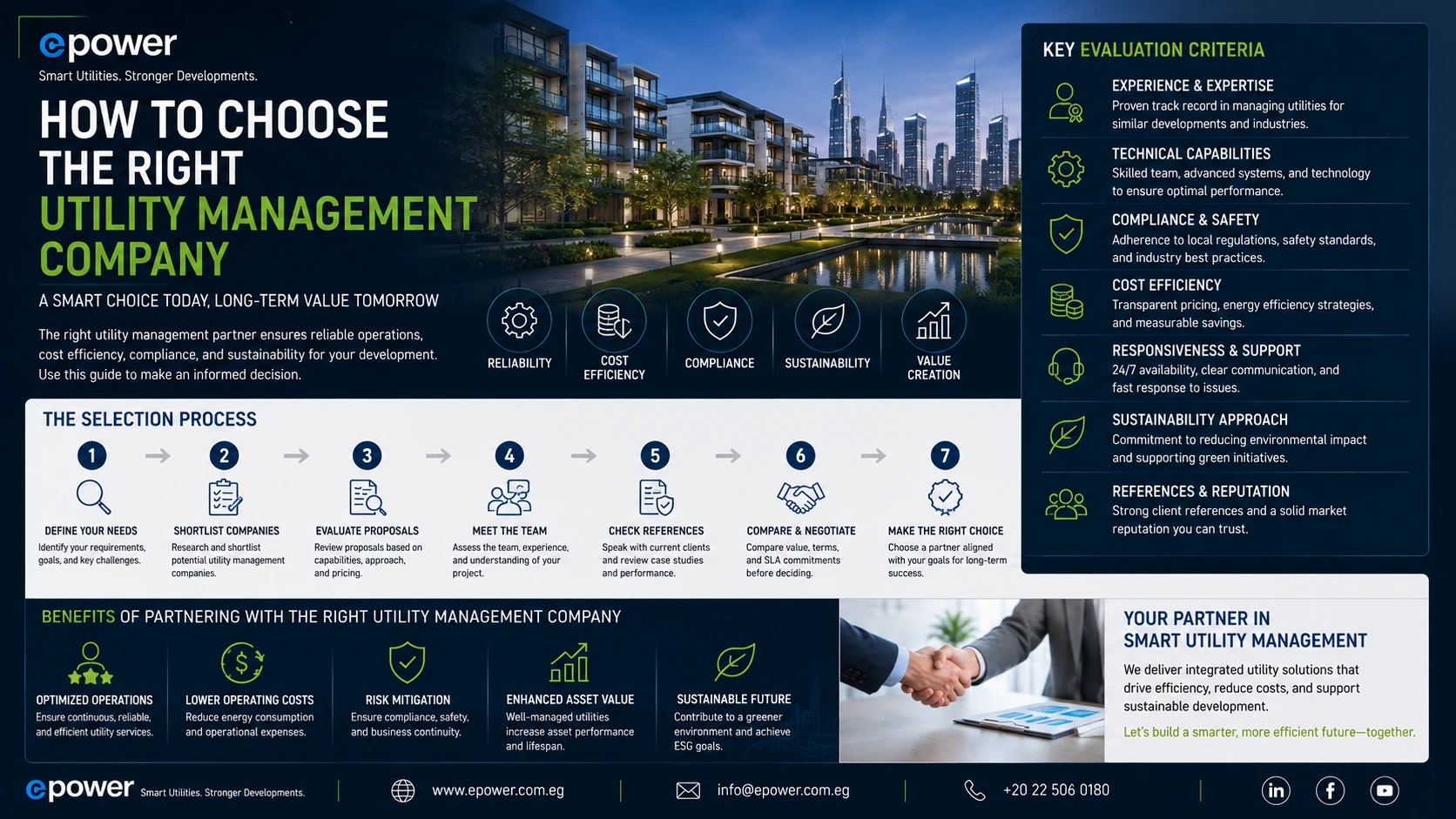
Choosing the right utility management company is a strategic decision for real estate developers, residential compounds, commercial centers, industrial parks, hotels, and mixed-use developments. The right provider can improve utility reliability, reduce operating costs, optimize energy consumption, and protect critical infrastructure.
However, selecting a provider based only on the lowest quotation can create operational and financial risks. A strong evaluation should consider technical expertise, service scope, digital capabilities, regulatory knowledge, maintenance strategy, response times, KPIs, and total cost of ownership.
What Does a Utility Management Company Do?
Definition
A utility management company operates and manages essential infrastructure and utility services on behalf of a property owner or developer.
Depending on the contract, services can include:
- Electricity distribution
- Water management
- Wastewater management
- Smart metering
- Utility billing
- Energy management
- Preventive maintenance
- Emergency response
- Asset management
- Utility monitoring
For electricity distribution specifically, EgyptERA identifies management, operation, and maintenance of licensed distribution networks as core responsibilities of licensed distribution companies.
Utility Management vs Facility Management
Utility management focuses primarily on infrastructure and resource services such as electricity, water, energy, metering, and distribution networks.
Facility management has a broader scope and can include building maintenance, HVAC, cleaning, security, landscaping, and other support services.
For large developments, the two disciplines can be integrated to create a single operational model.
Why Choosing the Right Utility Management Company Matters
Reliability of Essential Services
Electricity, water, cooling, and other utilities directly affect residents, tenants, businesses, and visitors. Poor utility management can lead to service interruptions and customer complaints.
Operational Cost Control
A capable provider should identify opportunities to reduce energy consumption, water losses, maintenance costs, and unnecessary operational expenditure.
Infrastructure Protection
Utility infrastructure represents a major long-term investment. Preventive and condition-based maintenance can help extend equipment life and reduce premature replacement.
Regulatory Compliance
Electricity distribution and utility operations in Egypt are subject to regulatory requirements. EgyptERA publishes electricity regulations, distribution codes, connection guidance, tariffs, and licensing information.
1. Evaluate the Company's Technical Expertise
Electrical Infrastructure Experience
For developments with private electrical networks, verify whether the provider has practical experience with:
- Medium-voltage networks
- Low-voltage distribution
- Transformers
- Substations
- Switchgear
- Protection systems
- Generators
- Smart meters
Technical expertise should match the complexity and scale of the development.
Water and Mechanical Expertise
If the scope includes water and wastewater, assess experience with:
- Water networks
- Pump stations
- Storage tanks
- Sewage systems
- Irrigation
- Pressure management
A multidisciplinary team is particularly valuable for large mixed-use developments.
2. Check Experience With Similar Projects
Project Type
A company experienced in industrial utilities may not necessarily have the operational capabilities required for a large residential compound.
Look for experience relevant to your development:
- Residential compounds
- Mixed-use developments
- Shopping malls
- Hotels and resorts
- Industrial facilities
- Business parks
- Smart cities
Project Scale
Consider whether the provider has successfully managed projects with comparable:
- Number of meters
- Electrical capacity
- Area
- Number of buildings
- Number of customers
- Utility complexity
Ask for documented case studies and references rather than relying solely on marketing claims.
3. Evaluate the Scope of Services
End-to-End Capability
A strong utility management company should be able to cover the services your project actually needs.
Potential scope includes:
Operations
Daily monitoring and operation of utility infrastructure.
Preventive Maintenance
Scheduled inspections and maintenance designed to reduce equipment failures.
Corrective Maintenance
Fast response to faults and equipment failures.
Emergency Response
24/7 support for critical utility incidents where required.
Metering
Installation, monitoring, testing, and management of electricity and water meters.
Billing
Consumption data processing, bill generation, payment management, and reporting where included in the contract.
Energy Management
Consumption analysis, efficiency programs, demand management, and performance optimization.
4. Assess Digital and Smart Utility Capabilities
Smart Metering
Smart meters can provide detailed consumption information and support remote data collection.
Centralized Monitoring
Ask whether the provider uses centralized platforms to monitor:
- Electricity consumption
- Water consumption
- Equipment status
- Network alarms
- Meter communication
- Utility performance
Data Analytics
A modern utility management company should be capable of transforming raw meter data into useful operational information.
Useful reports can identify:
- Abnormal consumption
- Peak demand
- Technical losses
- Water leaks
- Equipment inefficiencies
- Consumption trends
IFMA's utility benchmarking resources emphasize metrics such as energy use intensity, utility cost, maintenance cost, planned maintenance, and other performance indicators as tools for evaluating operational performance.
5. Look for Clear KPIs and SLAs
Why SLAs Matter
A utility management contract should clearly define the service level expected from the provider.
SLAs can address:
- Response time
- Resolution time
- Preventive maintenance completion
- System availability
- Emergency response
- Reporting frequency
Choose Measurable KPIs
Avoid vague requirements such as "excellent service."
Instead, define measurable indicators such as:
- Planned maintenance completion rate
- Average response time
- Mean Time to Repair (MTTR)
- Equipment availability
- Utility consumption
- Meter reading accuracy
- Customer complaint resolution time
IFMA guidance recommends that service levels be measurable, achievable, and within the supplier's control. It also recommends keeping critical KPIs focused rather than creating an unnecessarily complicated performance mechanism.
Performance-Based Contracts
Where appropriate, part of the provider's commercial performance can be linked to clearly defined KPIs.
This creates greater accountability and aligns the provider's objectives with the owner's operational goals.
6. Examine the Maintenance Strategy
Preventive Maintenance
Ask for the provider's preventive maintenance methodology.
A professional program should include:
- Asset register
- Maintenance schedules
- Inspection checklists
- Criticality assessment
- Maintenance history
- Spare-parts planning
Predictive Maintenance
More advanced providers may use:
- Thermal imaging
- Vibration monitoring
- Electrical condition monitoring
- Energy analytics
- IoT sensors
This allows maintenance teams to identify potential problems before equipment failure.
Reactive Maintenance
Emergency repairs will always be necessary, but the objective should be to reduce dependence on reactive maintenance through better planning and monitoring.
7. Verify Regulatory and Compliance Knowledge
EgyptERA Requirements
For electricity-related activities, the provider should understand the applicable EgyptERA framework, particularly where the project involves electricity distribution, licensing, tariffs, connection requirements, or regulated network operations.
EgyptERA publishes licensing procedures and documents for electricity distribution activities and provides official distribution codes and connection guidance.
Safety and Technical Standards
The provider should also demonstrate appropriate procedures for:
- Electrical safety
- Equipment testing
- Isolation procedures
- Emergency response
- Preventive maintenance
- Documentation
- Technical inspections
Compliance Documentation
Ask to see examples of:
- Inspection reports
- Test reports
- Maintenance records
- Compliance documentation
- Incident reports
8. Compare Total Cost of Ownership
Don't Choose Based on Price Alone
The cheapest quotation may not be the cheapest solution over five or ten years.
Compare:
- Management fees
- Staffing
- Technology
- Maintenance
- Spare parts
- Emergency services
- Energy performance
- Equipment lifecycle
- Additional works
- Contract exclusions
Calculate Long-Term Value
A provider that costs slightly more but reduces energy consumption, equipment failures, and downtime may create significantly greater value.
IFMA's facility management procurement guidance recommends value testing and benchmarking to assess whether a service continues to provide value for money, considering not only cost but also quality, productivity, environmental impact, and customer satisfaction.
9. Evaluate the Team, Not Just the Company
Management Team
Ask who will actually manage the account after contract award.
Technical Staff
Review:
- Engineering qualifications
- Certifications
- Experience
- Training
- Shift coverage
Local Availability
For critical infrastructure, response capability matters. A provider should have appropriate technical resources available within the required response time.
Staff Continuity
High employee turnover can negatively affect infrastructure knowledge and service quality.
10. Review Reporting and Transparency
Monthly Reports
A professional provider should provide regular reports covering:
- Utility consumption
- Maintenance activities
- Faults
- KPIs
- Energy performance
- Metering status
- Open work orders
- Major incidents
Real-Time Dashboards
For larger developments, dashboards can provide management teams with real-time visibility into utility performance.
Data Ownership
The contract should clearly establish who owns meter data, operational records, drawings, maintenance history, and other project information.
11. Assess Scalability
Future Development Phases
Real estate developments often expand in phases.
The selected utility management company should be able to support:
- Additional buildings
- Additional meters
- New substations
- New utility networks
- Increased customer numbers
- New technologies
Smart City Integration
If the development is intended to become a smart community, the provider should have the technology and operational capabilities to integrate future systems.
12. Check Customer and Resident Service Capabilities
Complaint Management
For residential communities, utility management often involves direct interaction with residents.
A provider may need systems for:
- Complaint registration
- Service requests
- Meter issues
- Billing questions
- Payment support
- Escalation
Response Performance
Customer satisfaction should be measured through objective indicators such as response time, resolution time, and complaint recurrence.
IFMA identifies customer satisfaction, system availability, MTTR, MTBF, preventive maintenance, and utility costs among useful facility management performance measures.
Utility Management Company Evaluation Checklist
Before selecting a provider, developers should evaluate:
Technical Capability
- Relevant engineering expertise
- Similar project experience
- Electrical distribution capabilities
- Water and wastewater capabilities
- Smart metering expertise
Operational Capability
- 24/7 support where required
- Preventive maintenance
- Emergency response
- Asset management
- Spare-parts strategy
Digital Capability
- Smart metering
- Centralized monitoring
- CMMS
- Utility analytics
- Digital reporting
Commercial Capability
- Transparent pricing
- Defined scope
- Clear exclusions
- SLA structure
- KPI mechanism
- Multi-year TCO
Compliance
- EgyptERA knowledge
- Applicable technical codes
- Safety procedures
- Documentation
- Licensing requirements where applicable
Red Flags to Watch For
Very Low Pricing
An unusually low quotation may indicate inadequate staffing, excluded services, or insufficient maintenance resources.
Vague Scope
If the contract does not clearly define responsibilities and exclusions, disputes are more likely later.
No Measurable KPIs
A provider should be willing to have its performance measured objectively.
Limited Reporting
Lack of reliable utility data makes it difficult to identify inefficiencies or verify performance.
Heavy Dependence on Reactive Maintenance
A provider that mainly responds to failures instead of preventing them can increase lifecycle costs.
No Relevant References
A company should be able to demonstrate experience with projects comparable to yours.
Why Choose epower?
epower provides integrated utility management solutions for residential compounds, commercial developments, industrial facilities, hotels, and mixed-use projects across Egypt.
Its capabilities combine electricity distribution, smart metering, utility monitoring, preventive maintenance, energy management, and technical operations. This integrated model allows developers to work with a specialized utility partner rather than coordinating multiple disconnected service providers.
epower focuses on measurable operational performance, reliable infrastructure, digital utility visibility, and long-term asset efficiency. Its approach can support developments from initial infrastructure operation through ongoing utility management and future expansion.
For projects involving regulated electricity distribution, selecting a provider with an understanding of Egypt's regulatory environment is particularly important. EgyptERA's framework covers electricity distribution licensing, technical codes, connection guidance, tariffs, and distribution responsibilities.
Conclusion
Knowing how to choose a utility management company requires looking beyond the monthly service fee. Developers should evaluate technical expertise, project experience, service scope, digital capabilities, maintenance strategy, regulatory knowledge, KPIs, SLAs, reporting, scalability, and total cost of ownership.
The ideal provider should function as a long-term operational partner rather than simply a manpower supplier. It should be capable of managing utility infrastructure proactively, using reliable data to improve performance, responding quickly to failures, and continuously identifying opportunities for cost and energy optimization.
For large developments, the strongest selection process combines technical due diligence, commercial evaluation, reference checks, site visits, and a clearly structured SLA and KPI framework. This creates a more objective basis for selecting a utility management partner capable of delivering reliable and sustainable infrastructure performance.
Frequently Asked Questions
What should I look for in a utility management company?
Look for relevant technical expertise, experience with similar projects, comprehensive service capabilities, smart metering and monitoring technology, preventive maintenance, strong KPIs, regulatory knowledge, and transparent commercial terms.
Should I choose the cheapest utility management company?
Not necessarily. The lowest initial price may result in higher long-term costs through poor maintenance, downtime, energy inefficiency, or excluded services. Compare providers using total cost of ownership and measurable performance.
What KPIs should a utility management company have?
Useful KPIs include system availability, preventive maintenance completion, MTTR, MTBF, response time, utility consumption, meter accuracy, energy efficiency, and customer complaint resolution.
Does a utility management company need EgyptERA licensing?
It depends on the activities and contractual scope. Electricity distribution activities that fall within the regulated framework may require the appropriate EgyptERA permit or license. EgyptERA publishes the relevant licensing procedures and requirements.
Can a utility management company manage smart meters?
Yes. Depending on its capabilities, a provider can manage smart meter deployment, communication, monitoring, consumption data, analytics, billing integration, and maintenance.
How can I compare two utility management companies?
Create a weighted evaluation covering technical capability, experience, scope, technology, staffing, SLAs, KPIs, compliance, references, and multi-year TCO rather than comparing quotations alone.
Why choose epower for utility management?
epower combines utility operations, electrical distribution, smart metering, energy management, preventive maintenance, and digital monitoring to help developers improve reliability, control operating costs, and optimize the long-term performance of their utility infrastructure.