
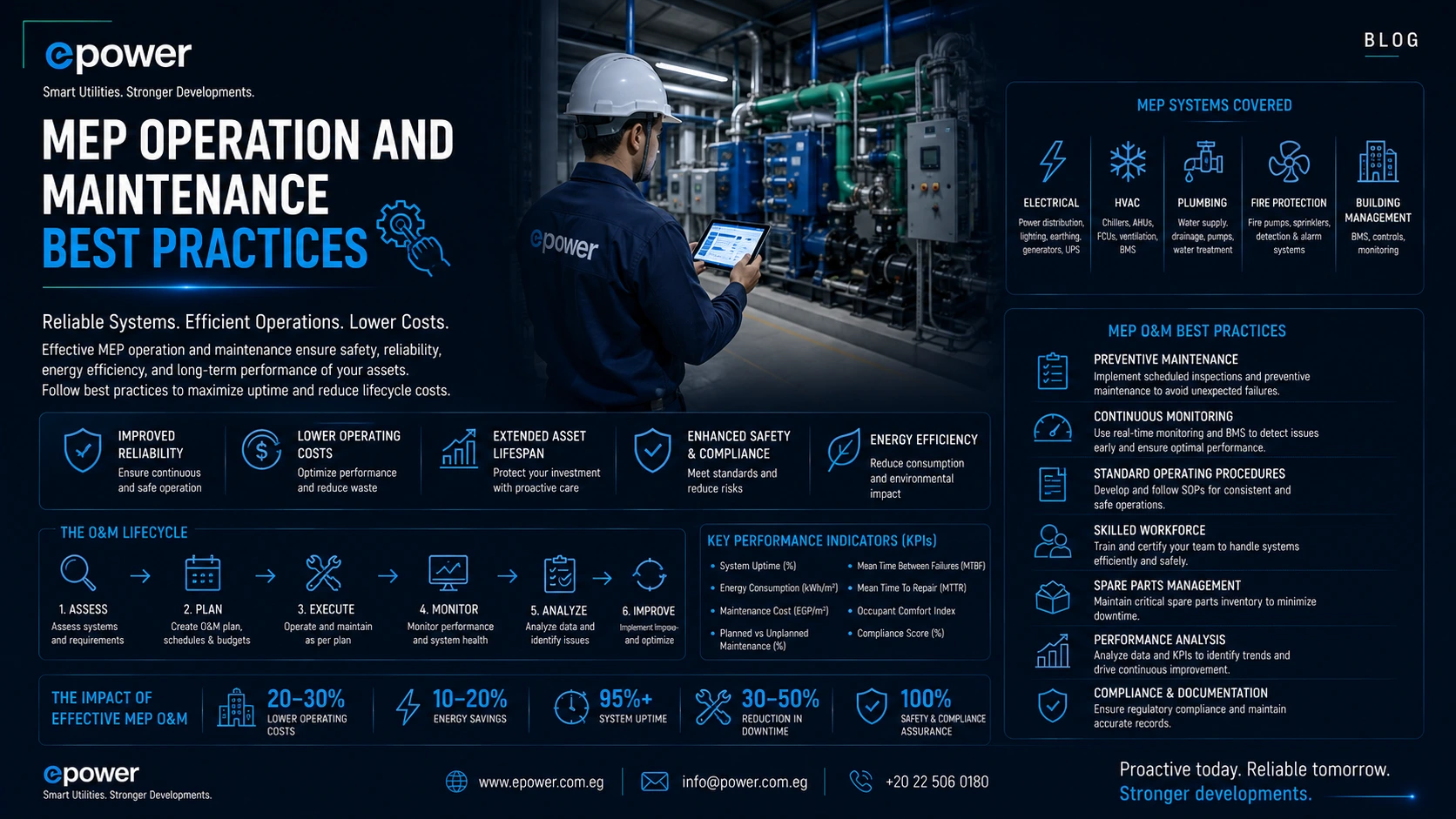
Mechanical, Electrical, and Plumbing (MEP) systems are essential to the safe, efficient, and reliable operation of modern buildings. From HVAC and electrical distribution to water supply and drainage systems, their performance directly affects occupant comfort, energy consumption, operational costs, and business continuity.
Following MEP Operation and Maintenance Best Practices allows facility owners and operators to move from reactive repairs toward proactive asset management. Industry guidance from ASHRAE and the U.S. Department of Energy emphasizes preventive maintenance, commissioning, monitoring, documentation, staff training, and data-driven optimization as key elements of effective building operations.
What is MEP Operation and Maintenance?
Definition
MEP operation and maintenance involves the systematic operation, inspection, servicing, testing, monitoring, and repair of mechanical, electrical, and plumbing systems throughout a facility's lifecycle.
An effective MEP program should balance reliability, safety, energy efficiency, occupant comfort, and maintenance costs rather than simply responding to equipment failures.
Main MEP Systems
Mechanical Systems
Mechanical systems commonly include:
- HVAC equipment
- Chillers
- Pumps
- Air handling units
- Fan coil units
- Ventilation systems
- Elevators and escalators
Electrical Systems
Electrical infrastructure may include:
- Transformers
- Switchgear
- Distribution boards
- Generators
- UPS systems
- Lighting
- Electrical protection systems
Plumbing Systems
Plumbing infrastructure includes:
- Water supply
- Pumps
- Storage tanks
- Drainage
- Sewage systems
- Hot water systems
- Fire water infrastructure
Establish a Preventive Maintenance Program
Build an Asset Register
The first step is to create an accurate inventory of all MEP assets.
Each asset should have information such as:
- Equipment identification number
- Location
- Manufacturer
- Model
- Capacity
- Installation date
- Maintenance history
- Criticality
- Warranty information
This creates a reliable foundation for maintenance planning.
Define Maintenance Frequencies
Maintenance schedules should be based on manufacturer recommendations, operating conditions, asset criticality, applicable standards, and historical performance.
Tasks can be organized into:
Daily Inspections
Operators check critical operating parameters, alarms, abnormal sounds, leaks, temperatures, pressures, and equipment status.
Monthly and Quarterly Maintenance
Technicians perform inspections, cleaning, testing, lubrication, electrical checks, and performance verification according to the equipment and system requirements.
Annual Maintenance
Annual programs should include comprehensive inspections, functional testing, calibration, system optimization, and review of equipment condition.
ASHRAE Standard 180, for example, establishes minimum HVAC inspection and maintenance requirements intended to preserve thermal comfort, energy efficiency, and indoor air quality in commercial buildings.
Apply Condition-Based and Predictive Maintenance
Move Beyond Reactive Maintenance
Reactive maintenance means repairing equipment after failure. While it remains necessary for unexpected breakdowns, relying on it as the primary strategy can increase downtime and emergency repair costs.
A stronger approach combines corrective, preventive, predictive, and reliability-centered maintenance according to asset criticality and operating conditions.
Monitor Equipment Condition
Sensors and monitoring systems can track:
- Temperature
- Vibration
- Pressure
- Current
- Voltage
- Energy consumption
- Flow rates
Changes from normal operating conditions can indicate developing equipment problems.
Use Predictive Analytics
Predictive maintenance uses equipment data to identify potential failures before they occur. This allows maintenance teams to plan interventions, order spare parts, and schedule shutdowns with less disruption.
Optimize HVAC Operation and Maintenance
Maintain Air-Conditioning Equipment
HVAC systems often represent a significant portion of building energy consumption, making proper operation and maintenance particularly important.
Best practices include:
- Cleaning filters regularly
- Inspecting coils
- Checking refrigerant systems
- Maintaining fans and motors
- Inspecting belts and bearings
- Checking dampers
- Monitoring temperatures and pressures
ASHRAE identifies inspection and maintenance as fundamental to maintaining HVAC performance, energy efficiency, thermal comfort, and indoor air quality.
Optimize Chiller Performance
For central cooling systems, operators should continuously monitor:
- Chiller efficiency
- Entering and leaving water temperatures
- Condenser performance
- Pump operation
- Cooling tower performance
- System pressure
Performance data can reveal declining efficiency before it develops into a major operational problem.
Maintain Electrical Systems Proactively
Inspect Distribution Equipment
Regular inspection of transformers, switchgear, panels, cables, and protective devices helps identify potential failures.
Maintenance may include:
- Visual inspections
- Thermal imaging
- Electrical testing
- Protection relay testing
- Connection tightening where appropriate
- Insulation testing
- Load monitoring
Test Backup Power Systems
Generators, UPS systems, batteries, and automatic transfer systems should be periodically tested to ensure they can perform when normal power is unavailable.
Monitor Power Quality
Monitoring voltage, current, power factor, harmonics, and phase balance helps identify electrical problems that can damage sensitive equipment or increase energy consumption.
Improve Plumbing System Maintenance
Inspect Water Networks
Regular inspections should cover pipes, valves, pumps, tanks, pressure levels, and water distribution equipment.
Detect Leaks Early
Water leaks can cause significant financial and structural damage when they remain undetected.
Smart water meters, flow sensors, and abnormal-consumption alerts can help operators identify potential leaks quickly.
Maintain Pumps and Tanks
Preventive inspection of pumps, motors, storage tanks, and control systems helps ensure reliable water supply and reduces unexpected service interruptions.
Use CMMS for MEP Maintenance Management
Centralize Maintenance Information
A Computerized Maintenance Management System (CMMS) can organize:
- Work orders
- Preventive maintenance schedules
- Asset records
- Spare parts
- Technician assignments
- Maintenance history
- Inspection checklists
ASHRAE identifies CMMS knowledge as an important component of modern building operation and maintenance programs.
Track Maintenance KPIs
Useful MEP maintenance KPIs include:
- Planned vs. reactive maintenance
- Equipment downtime
- Mean Time Between Failures (MTBF)
- Mean Time to Repair (MTTR)
- Preventive maintenance completion rate
- Work-order response time
- Energy consumption
- Maintenance cost per asset
KPIs help facility managers identify weak points and continuously improve maintenance performance. The U.S. Department of Energy also recommends using KPIs to measure O&M performance and identify areas requiring improvement.
Integrate Energy Management
Monitor Energy Consumption
Energy monitoring systems provide information about electricity, cooling, and water consumption.
Facility teams can use this information to identify:
- Abnormal consumption
- Peak demand
- Inefficient equipment
- Unnecessary operating hours
- Opportunities for optimization
Recommission Building Systems
Buildings can gradually move away from their original operating conditions as equipment ages, occupancy changes, or control settings are modified.
Recommissioning involves testing and adjusting systems to improve performance and align them with current operational requirements.
Use Building Automation
Building Management Systems can help optimize HVAC, lighting, and other building systems by adjusting operation according to actual demand.
Maintain Accurate MEP Documentation
Create Systems Manuals
Facility teams should have updated documentation covering system design, equipment information, operating procedures, maintenance requirements, and emergency procedures.
ASHRAE Guideline 1.4 specifically addresses systems manuals as resources for facility training, operation, maintenance, and future upgrades.
Document Maintenance Activities
Every significant maintenance activity should be recorded, including:
- Work performed
- Equipment condition
- Parts replaced
- Test results
- Technician
- Date
- Follow-up actions
Good documentation creates a history that can support future maintenance and asset replacement decisions.
Prioritize Safety and Staff Training
Implement Safe Work Procedures
MEP maintenance should always follow approved safety procedures, risk assessments, isolation requirements, and applicable regulations.
Electrical maintenance, mechanical work, confined-space activities, and other high-risk tasks require appropriately trained personnel and controlled procedures.
Train Facility Teams
Training should cover:
- Equipment operation
- Emergency procedures
- Safety requirements
- Control systems
- Maintenance procedures
- Energy optimization
- New technologies
Effective commissioning guidance also emphasizes documentation and training of operations and maintenance personnel.
Use Commissioning as an Ongoing Process
Verify System Performance
Commissioning should not be viewed as something that ends when a building opens. Existing buildings can benefit from recommissioning and ongoing commissioning to verify system performance and identify operational improvements.
Update Operational Baselines
Commissioning data can establish normal operating conditions for equipment. Future deviations can then be identified more easily through monitoring and analytics.
ASHRAE's commissioning guidance includes performance measurement, investigation of unacceptable outcomes, system-manual updates, O&M-plan updates, and personnel training as part of ongoing commissioning.
Benefits of Following MEP Operation and Maintenance Best Practices
Higher Reliability
Proactive maintenance reduces unexpected equipment failures and improves operational continuity.
Lower Operating Costs
Efficient equipment operation, preventive maintenance, and energy optimization can reduce both maintenance and utility expenses. The U.S. Department of Energy describes effective O&M as one of the most cost-effective strategies for improving building reliability, safety, longevity, and energy efficiency.
Longer Asset Lifespan
Regular inspections and timely repairs help protect expensive MEP equipment and delay premature replacement.
Improved Energy Efficiency
Properly maintained HVAC, electrical, pumping, and control systems operate closer to their intended performance levels.
Better Occupant Comfort
Well-maintained HVAC, plumbing, lighting, and building systems create a more reliable and comfortable environment.
Enhanced Safety
Structured inspection, testing, documentation, and training programs reduce operational risks.
Why Choose epower?
epower provides comprehensive MEP operation and maintenance solutions designed to improve the reliability, efficiency, and lifecycle performance of modern facilities across Egypt.
Its services can cover mechanical, electrical, and plumbing systems through preventive maintenance, corrective maintenance, condition monitoring, energy optimization, technical operations, and asset management. By combining experienced engineering teams with digital monitoring and structured maintenance programs, epower helps facility owners reduce downtime, control operating costs, extend asset life, and maintain reliable building performance.
For complex commercial, residential, industrial, hospitality, and mixed-use developments, epower can provide an integrated approach that connects MEP maintenance with broader facility and utility management objectives.
Conclusion
Effective MEP Operation and Maintenance Best Practices are based on a proactive approach rather than simply repairing equipment after failure. Preventive maintenance, predictive monitoring, accurate documentation, energy management, commissioning, staff training, and performance measurement work together to create more reliable and efficient facilities.
For building owners and operators, the objective should be to treat MEP systems as long-term assets rather than individual pieces of equipment. A structured O&M strategy protects those assets, improves energy performance, reduces operational risk, and supports consistent building performance throughout the facility lifecycle.
Frequently Asked Questions
What are MEP operation and maintenance best practices?
They are structured procedures for operating, inspecting, maintaining, testing, and optimizing mechanical, electrical, and plumbing systems to improve reliability, safety, efficiency, and asset lifespan.
What is the most important MEP maintenance strategy?
A proactive strategy combining preventive, predictive, and condition-based maintenance is generally more effective than relying primarily on reactive repairs. The appropriate mix depends on asset criticality and operating conditions.
How often should MEP equipment be maintained?
There is no single frequency for every asset. Maintenance intervals should consider manufacturer recommendations, applicable standards, operating conditions, equipment criticality, and historical performance.
How does CMMS improve MEP maintenance?
A CMMS centralizes asset information, work orders, preventive maintenance schedules, spare parts, maintenance history, and performance data, making maintenance activities easier to plan and track.
Can MEP maintenance reduce energy consumption?
Yes. Proper maintenance and optimized operation can improve HVAC, electrical, pumping, and control-system efficiency. The U.S. Department of Energy identifies effective O&M as a cost-effective way to improve building energy efficiency.
What is commissioning in MEP operations?
Commissioning is a systematic process used to verify that building systems perform according to operational requirements. Recommissioning and ongoing commissioning can help existing facilities identify and correct performance issues over time.
Why choose epower for MEP operation and maintenance?
epower combines engineering expertise, preventive maintenance, technical operations, energy optimization, and asset management to help facilities achieve reliable MEP performance, lower operating costs, and longer equipment lifecycles.