
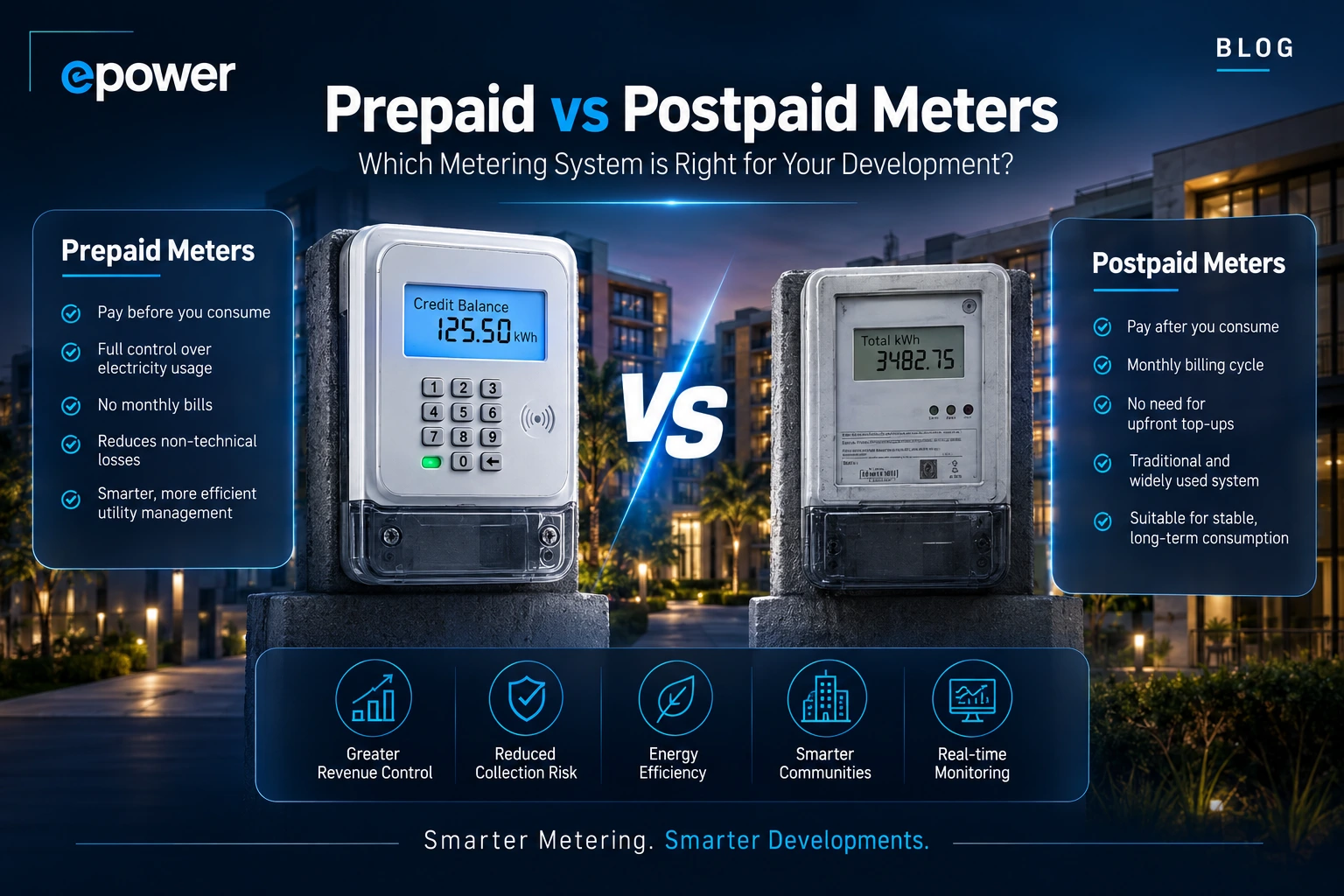
As utilities and property developers continue to modernize electricity management, smart metering technologies have become an essential part of efficient energy distribution. One of the most common decisions for utility providers, residential compounds, commercial developments, and industrial facilities is choosing between prepaid vs postpaid meters.
Both systems accurately measure electricity consumption, but they differ significantly in payment methods, billing processes, operational efficiency, and customer management. Understanding the differences between prepaid and postpaid meters helps developers, facility managers, and utility operators select the most suitable solution for their projects.
With advances in smart metering technology, both prepaid and postpaid systems now offer digital monitoring, remote communication, real-time consumption tracking, and improved billing accuracy.
What are Prepaid and Postpaid Meters?
Prepaid Meters
A prepaid electricity meter requires users to purchase electricity credit before consuming power. The available balance decreases as electricity is used, and once the balance reaches zero, the electricity supply is automatically disconnected until additional credit is purchased.
Prepaid meters provide consumers with complete control over their electricity spending while eliminating monthly billing and payment collection challenges.
Postpaid Meters
A postpaid electricity meter records electricity consumption throughout the billing period. Customers receive a bill after the electricity has been used and make payment according to the agreed billing cycle.
This is the traditional metering system widely used in residential, commercial, and industrial sectors worldwide.
Prepaid vs Postpaid Meters: Key Differences
Feature
Prepaid Meter
Postpaid Meter
Payment Method
Pay before consumption
Pay after consumption
Billing
No monthly bills
Monthly or periodic billing
Electricity Supply
Stops when balance reaches zero
Continues until payment due
Budget Control
Excellent
Moderate
Debt Risk
Very low
Higher
Revenue Collection
Immediate
Delayed
Administrative Costs
Lower
Higher
Remote Recharge
Supported in smart systems
Not applicable
Credit Risk
Minimal
Depends on customer payments
Advantages of Prepaid Meters
Better Budget Control
Consumers can monitor their electricity usage in real time and manage spending according to their available balance.
Improved Revenue Collection
Utility providers receive payment before electricity is consumed, eliminating unpaid bills and reducing financial risk.
Reduced Administrative Costs
Prepaid systems eliminate many manual billing and payment collection processes.
Lower Energy Theft
Modern prepaid smart meters include advanced security features that help detect tampering and unauthorized usage.
Real-Time Consumption Monitoring
Users can track electricity consumption instantly through mobile applications or online platforms.
Advantages of Postpaid Meters
Continuous Electricity Supply
Customers continue receiving electricity throughout the billing cycle without needing to recharge their account.
Familiar Billing Process
Many residential and commercial customers prefer traditional monthly billing systems.
Suitable for High-Consumption Users
Industrial facilities, commercial buildings, and large organizations often prefer postpaid billing due to predictable operational processes.
Flexible Payment Options
Customers can typically pay invoices through banks, mobile applications, online payment portals, or utility offices.
When Should You Choose Prepaid Meters?
Prepaid meters are ideal for:
- Residential compounds
- Student housing
- Rental properties
- Affordable housing projects
- Worker accommodations
- Mixed-use developments
- Utility management companies
- Smart cities
They are particularly effective where cost control, automated billing, and revenue protection are priorities.
When Should You Choose Postpaid Meters?
Postpaid meters are commonly used for:
- Large commercial buildings
- Corporate offices
- Industrial facilities
- Government buildings
- Hospitals
- Educational institutions
- Traditional residential neighborhoods
These environments often require established billing systems and long-term customer relationships.
Smart Metering Features Available in Both Systems
Modern prepaid and postpaid meters can both include advanced smart metering capabilities such as:
Remote Meter Reading
Utility providers can collect consumption data remotely without visiting customer premises.
Real-Time Monitoring
Energy consumption is continuously monitored and reported through centralized management platforms.
Remote Connection and Disconnection
Authorized operators can remotely connect or disconnect electricity services when required.
Load Management
Utilities can monitor electrical loads and improve network efficiency.
Tamper Detection
Smart meters detect unauthorized access, meter bypass, and abnormal operating conditions.
Data Analytics
Detailed energy reports help utilities optimize network performance and identify consumption trends.
Factors to Consider When Choosing
When selecting between prepaid vs postpaid meters, developers and utility providers should evaluate:
- Project type
- Customer profile
- Revenue collection strategy
- Utility management requirements
- Billing preferences
- Infrastructure costs
- Smart city integration
- Future scalability
The right solution depends on operational goals, regulatory requirements, and the long-term management strategy of the development.
Why Smart Metering Matters
As electricity networks become increasingly digital, smart metering enables utilities to improve operational efficiency, reduce energy losses, automate billing, and provide better customer services.
Whether using prepaid or postpaid billing models, smart meters support real-time monitoring, predictive maintenance, and data-driven decision-making that contributes to more reliable and sustainable electricity distribution.
Why Choose epower?
epower provides advanced smart metering solutions designed to support modern electricity distribution networks across residential, commercial, industrial, and mixed-use developments. From prepaid and postpaid metering systems to smart meter integration, utility management platforms, remote monitoring, and energy optimization, epower delivers complete end-to-end solutions tailored to each project's operational requirements.
With extensive expertise in electrical infrastructure, smart utility technologies, and energy management, epower helps developers and utility operators improve billing accuracy, enhance revenue collection, optimize energy consumption, and build scalable metering systems that support the future of digital utilities.
Conclusion
Choosing between prepaid vs postpaid meters depends on the operational needs of the project, customer expectations, and long-term utility management objectives. Prepaid meters provide greater cost control, improved revenue security, and simplified billing, while postpaid meters offer flexibility and familiarity for many commercial and industrial users.
As smart metering technology continues to evolve, both solutions deliver accurate consumption monitoring, enhanced operational efficiency, and improved customer experiences, making them essential components of modern electricity distribution systems.
Frequently Asked Questions
What is the difference between prepaid and postpaid meters?
Prepaid meters require customers to pay before using electricity, while postpaid meters allow customers to consume electricity first and pay according to a billing cycle.
Which meter is better for residential compounds?
Prepaid smart meters are often preferred because they improve billing efficiency, reduce payment defaults, and give residents better control over electricity expenses.
Are prepaid meters more accurate than postpaid meters?
Both prepaid and postpaid smart meters provide highly accurate electricity measurement. The primary difference lies in the payment model rather than measurement accuracy.
Can both systems support smart metering?
Yes. Modern prepaid and postpaid meters both support smart features such as remote meter reading, real-time monitoring, tamper detection, and data analytics.
Which system is better for utility companies?
Prepaid systems generally improve cash flow and reduce collection risks, while postpaid systems remain suitable for customers with established billing relationships and predictable payment histories.
Why choose epower for smart metering solutions?
epower delivers complete smart metering solutions, including prepaid and postpaid systems, remote monitoring, utility management platforms, and integrated electrical infrastructure that help developers and utility providers improve efficiency, billing accuracy, and long-term operational performance.