
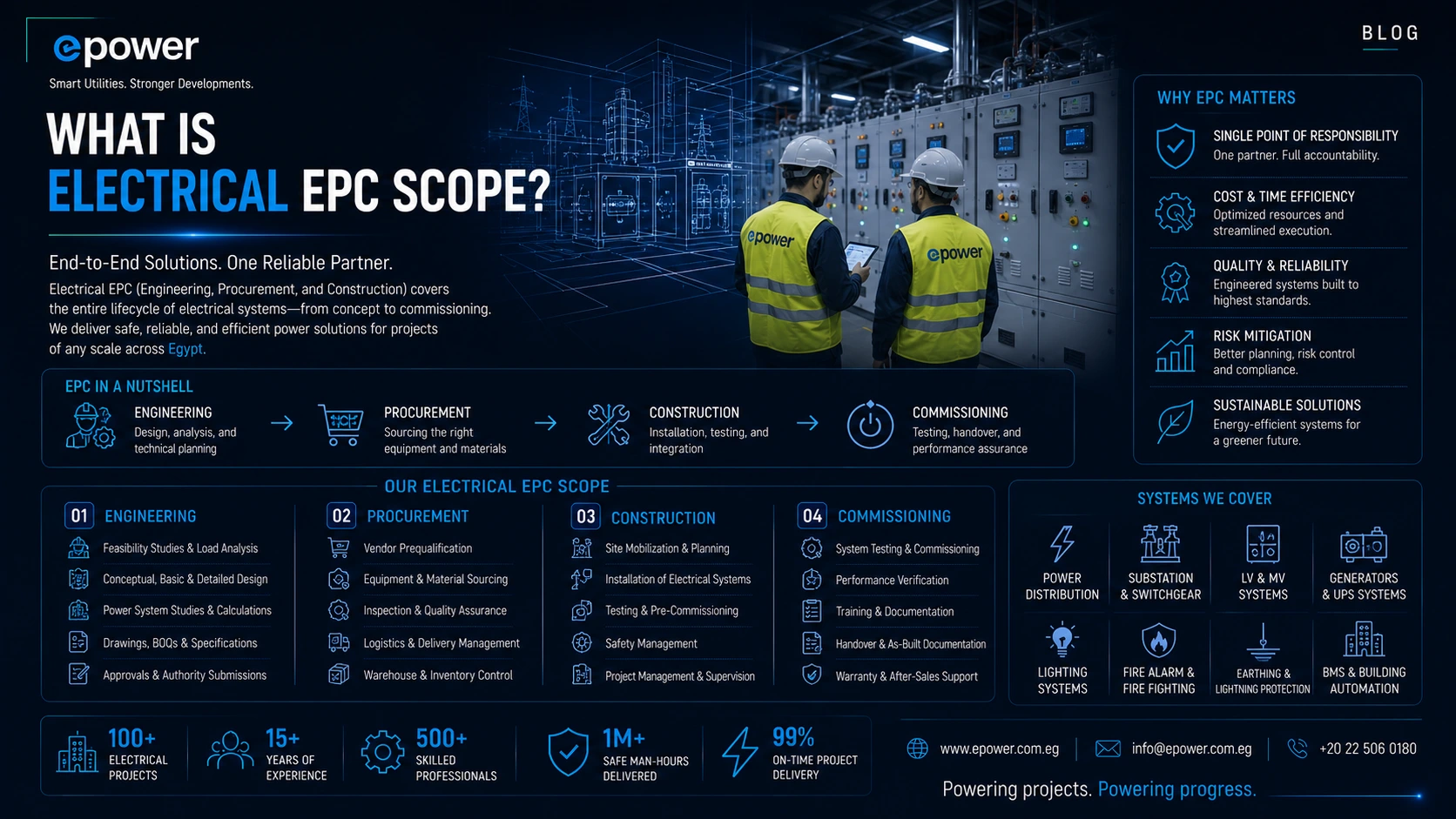
Understanding what is electrical EPC scope is essential for developers, industrial companies, contractors, and project owners planning electrical infrastructure projects. Electrical EPC stands for Engineering, Procurement, and Construction, a project delivery model in which one contractor takes responsibility for designing, sourcing, installing, testing, and commissioning the electrical systems required for a project.
A clearly defined EPC scope establishes responsibilities, technical requirements, deliverables, interfaces, quality standards, and project boundaries. This helps minimize misunderstandings, control costs, reduce delays, and ensure that the completed electrical system performs according to the project's requirements.
What Does Electrical EPC Mean?
Engineering, Procurement, and Construction
When asking what is electrical EPC scope, the first step is understanding the three main phases.
Engineering
Engineering covers the technical design and documentation required before procurement and construction.
Procurement
Procurement involves sourcing electrical equipment, materials, and services according to approved technical specifications.
Construction
Construction covers installation, testing, commissioning, and handover of the electrical systems.
The EPC contractor coordinates these activities under one integrated project execution strategy.
What is Included in an Electrical EPC Scope?
Electrical Engineering and Design
Engineering is the foundation of an electrical EPC project.
Typical deliverables include:
Load Calculations
Engineers calculate electrical demand to determine the required capacity of transformers, generators, cables, switchgear, and other equipment.
Single-Line Diagrams
Single-line diagrams show how electricity flows through the distribution system and define major electrical equipment and protection arrangements.
Cable Sizing
Engineers select cables according to current-carrying capacity, voltage drop, short-circuit requirements, installation conditions, and applicable standards.
Protection Coordination
Protection studies determine appropriate settings for circuit breakers and protection relays so electrical faults can be isolated while minimizing disruption to the rest of the network.
Lighting Design
The engineering scope may include internal lighting, external lighting, emergency lighting, and control systems.
Earthing and Lightning Protection
Design includes grounding networks and lightning protection systems intended to protect people, equipment, and buildings.
Electrical Equipment Procurement
Equipment Selection
Once engineering requirements are established, the EPC contractor identifies suitable equipment that meets approved specifications.
Common equipment includes:
- Transformers
- MV switchgear
- LV switchboards
- Distribution boards
- Motor Control Centers
- Generators
- UPS systems
- Protection relays
- Cables
- Cable trays
- Busbars
- Lighting equipment
- Earthing materials
Vendor Evaluation
A professional EPC contractor evaluates suppliers based on technical compliance, quality, certifications, manufacturing capability, delivery schedules, and commercial terms.
Factory Acceptance Testing
For critical equipment, Factory Acceptance Tests (FAT) may be performed before shipment to verify that equipment meets specified technical and performance requirements.
Electrical Construction Scope
Installation
Construction activities typically include installation of:
- Transformers
- Switchgear
- Electrical panels
- Generators
- UPS systems
- Cable trays
- Busbar systems
- Power and control cables
Cable Installation
Cable installation includes routing, pulling, termination, identification, testing, and documentation according to project requirements.
Electrical Connections
The contractor connects equipment and distribution systems while ensuring proper termination, grounding, labeling, and protection.
Earthing Installation
Grounding systems are installed and tested to provide an appropriate path for fault currents and support electrical safety.
Testing and Commissioning
Pre-Commissioning Tests
Before energization, electrical equipment undergoes inspections and testing to verify installation quality and readiness.
Tests may include:
- Insulation resistance
- Continuity
- Earth resistance
- Cable testing
- Transformer testing
- Circuit breaker testing
Protection Relay Testing
Protection systems are tested to verify that relays and associated equipment respond correctly to fault conditions.
Functional Testing
Equipment is operated under controlled conditions to confirm that systems function according to approved designs.
Energization
After successful testing and approval, electrical systems can be energized according to an approved commissioning sequence.
Performance Verification
The EPC contractor verifies that completed systems meet the required technical and operational performance criteria.
Project Management Within the EPC Scope
Planning and Scheduling
The EPC contractor develops an execution schedule covering engineering, procurement, construction, testing, commissioning, and handover.
Quality Management
Quality control procedures verify that materials, equipment, installation, and testing comply with project specifications.
Health and Safety
Electrical EPC projects require strict HSE procedures covering site activities, electrical isolation, working at height, lifting operations, and other construction risks.
Documentation Control
Project documentation should be controlled throughout execution to ensure the client receives accurate final records.
Electrical EPC Handover
As-Built Documentation
The final documentation should reflect the electrical systems as actually installed.
Typical documents include:
- As-built drawings
- Equipment schedules
- Cable schedules
- Test reports
- Commissioning records
- Operation manuals
- Maintenance manuals
- Equipment datasheets
Training
Depending on the contract, the EPC contractor may train the client's operations and maintenance personnel on system operation and maintenance requirements.
Final Acceptance
The project is formally handed over after completion of testing, documentation, outstanding works, and contractual acceptance requirements.
Electrical EPC Scope by Project Type
Industrial Projects
Industrial EPC scopes often include:
- MV distribution
- Substations
- Transformers
- MCCs
- Motor systems
- Industrial lighting
- Emergency power
- Power quality systems
Commercial Buildings
Commercial projects may require:
- LV distribution
- Lighting
- Emergency systems
- Generators
- UPS
- BMS integration
- Fire alarm interfaces
Residential Developments
Residential electrical EPC scopes can include:
- Distribution substations
- MV networks
- LV networks
- Smart meters
- Street lighting
- Common-area power
- EV charging infrastructure
Renewable Energy Projects
Renewable projects may include:
- Solar PV electrical systems
- Inverters
- Transformers
- MV collection systems
- Grid connection
- Protection systems
- Monitoring and control
Why a Clearly Defined EPC Scope Matters
Cost Control
A detailed scope establishes exactly what the contractor is responsible for, reducing unexpected costs and scope disputes.
Schedule Management
Clearly defined deliverables allow engineering, procurement, and construction activities to be coordinated effectively.
Risk Reduction
Defining technical requirements and project interfaces early helps identify risks before construction begins.
Quality Assurance
A comprehensive scope establishes the standards, testing requirements, and documentation expected from the EPC contractor.
Better Accountability
An integrated EPC model creates a single point of responsibility for the project's electrical delivery.
Common Exclusions From Electrical EPC Scope
Utility Connection Fees
Depending on the contract, utility authority fees and connection charges may remain the client's responsibility.
Civil Works
Major civil construction may be excluded unless specifically included in the EPC contract.
Building Systems
Some projects treat HVAC, fire protection, telecommunications, or other systems as separate scopes unless explicitly integrated.
Future Expansion
Infrastructure intended for future phases should be clearly identified to avoid confusion about the contractor's current responsibilities.
Every project should therefore include a detailed scope of work and an explicit list of exclusions.
How to Define an Effective Electrical EPC Scope
Establish Project Requirements
Start by defining:
- Electrical load
- Voltage levels
- Project capacity
- Applicable standards
- Completion date
- Performance requirements
Define Deliverables
Specify every required engineering document, equipment package, installation activity, test, report, and handover document.
Define Interfaces
Electrical systems often interface with civil, mechanical, architectural, ICT, fire protection, and utility systems. These interfaces should be clearly assigned.
Define Acceptance Criteria
Testing, commissioning, performance requirements, and final acceptance procedures should be agreed before construction begins.
Why Choose epower?
epower provides comprehensive electrical EPC solutions covering the complete project lifecycle, from engineering and procurement to construction, testing, commissioning, and handover. The company's approach is designed to give developers, industrial facilities, commercial projects, and infrastructure owners a single point of responsibility for their electrical infrastructure.
By combining electrical engineering expertise, procurement management, project execution, quality control, HSE practices, and commissioning capabilities, epower helps clients deliver reliable and scalable electrical systems while maintaining control over project cost, schedule, and performance.
Conclusion
Understanding what is electrical EPC scope is critical before starting any major electrical infrastructure project. A complete scope should clearly define engineering deliverables, equipment procurement, installation, testing, commissioning, documentation, project management, and handover requirements.
The more precisely the scope is defined, the easier it becomes to control costs, manage interfaces, reduce project risks, and ensure the completed electrical system meets its intended performance.
For large industrial, commercial, residential, and infrastructure projects, working with an experienced electrical EPC contractor can provide the integrated expertise needed to move from initial design to a fully operational electrical system.
Frequently Asked Questions
What is an electrical EPC scope?
An electrical EPC scope defines all engineering, procurement, construction, testing, commissioning, documentation, and handover activities required to deliver an electrical project.
What are the three main phases of EPC?
The three main phases are Engineering, Procurement, and Construction, followed by testing, commissioning, and final handover as part of project completion.
Does electrical EPC include testing and commissioning?
Yes. A comprehensive electrical EPC scope typically includes pre-commissioning tests, functional testing, protection testing, energization, commissioning, and performance verification.
What equipment is usually included in an electrical EPC project?
Common equipment includes transformers, MV and LV switchgear, electrical panels, generators, UPS systems, cables, busbars, protection relays, lighting systems, and earthing equipment.
Why is defining EPC scope important?
A clearly defined scope establishes responsibilities, deliverables, technical requirements, interfaces, and acceptance criteria, helping reduce cost overruns, delays, and contractual disputes.
What should be included in an EPC handover?
Handover documentation typically includes as-built drawings, equipment schedules, test reports, commissioning records, operation and maintenance manuals, and relevant equipment documentation.
Why choose epower for electrical EPC projects?
epower provides end-to-end electrical EPC services, combining engineering, procurement, construction, testing, commissioning, and project management to deliver reliable electrical infrastructure tailored to the project's technical and operational requirements.